
When my brother-in-law first called me about solar, his opening question was exactly what most people ask: ‘How many panels do I need?’ He had been quoted 22 panels by one installer and 31 panels by another — for the same house. He wanted to know which one was right.
The answer, as it turned out, was that both quotes were technically defensible — but based on completely different assumptions about his household usage, the panel wattage being used, and whether he wanted to cover 80% or 100% of his electricity consumption. The 22-panel quote used 400W panels. The 31-panel quote used 285W panels. Both systems would have produced very similar annual output. The installers just hadn’t explained any of this.
The question ‘how many solar panels to power a house’ sounds straightforward. But the honest answer depends on four variables: how much electricity your household uses, how many hours of useful sunlight your location receives, the wattage rating of the panels you choose, and what percentage of your usage you want to cover. Get the inputs right and the calculation is simple. This guide walks you through every step.
The Quick Answer:
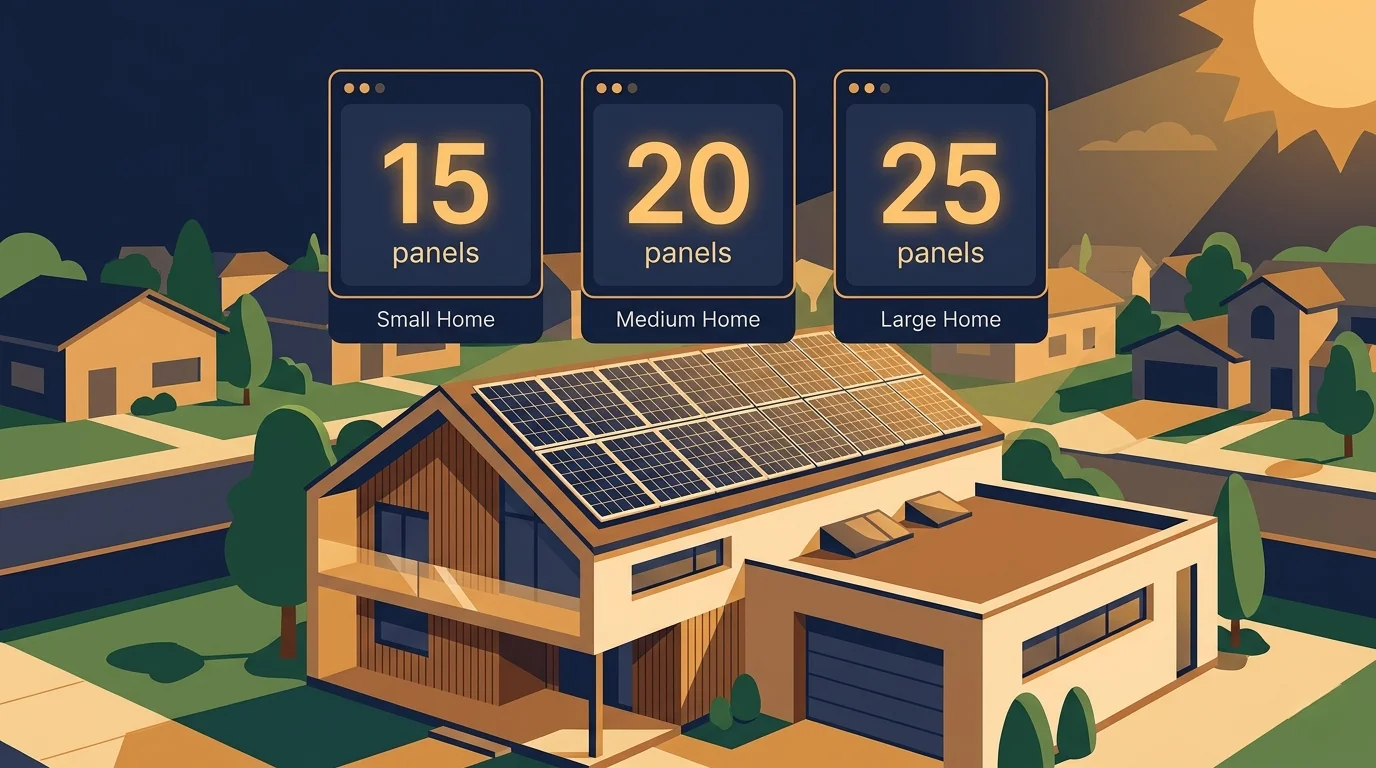
| The average US home needs 15 to 25 solar panels (at 400W each) to cover 100% of its electricity usage. A smaller 2-bedroom home might need just 10 to 14 panels. A large 4-bedroom home with an electric vehicle could need 28 to 35. The exact number depends on your monthly electricity consumption, your location’s peak sun hours, and the wattage of the panels you choose. |
📊 EIA: U.S. Energy Information Administration — Residential Electricity Consumption Survey 2026
How Many Solar Panels Does a House Need in 2026?
The number of solar panels your home needs is determined by one core calculation: how much electricity your home uses divided by how much electricity each panel produces in your location. Every other variable — panel wattage, roof space, system voltage — flows from this foundation.
In 2026, the most common residential solar panel is rated at 400 watts. Using 400W panels as the baseline, here is the quick-reference breakdown for US homes at an average of 4.5 peak sun hours per day:
| 15–25 | 400W | 900 kWh/mo | 6–10 kW |
| panels for avg US home | most common panel size 2026 | avg US household usage | typical US home system size |
These figures assume a system designed to cover approximately 90 to 100% of annual electricity usage, a system efficiency factor of 80%, and average US sun hours. For a personalised panel count based on your exact bill and postcode, our calculator does the maths automatically.
→ Use our how many solar panels do I need calculator for your exact number in under 2 minutes.
How Many Solar Panels by House Size — Complete Reference Table
Home size is a useful first proxy for electricity consumption, though actual usage varies significantly based on occupancy, appliances, climate control, and whether you have an electric vehicle. Here is the breakdown by typical US home size using 400W panels at average US sun hours:
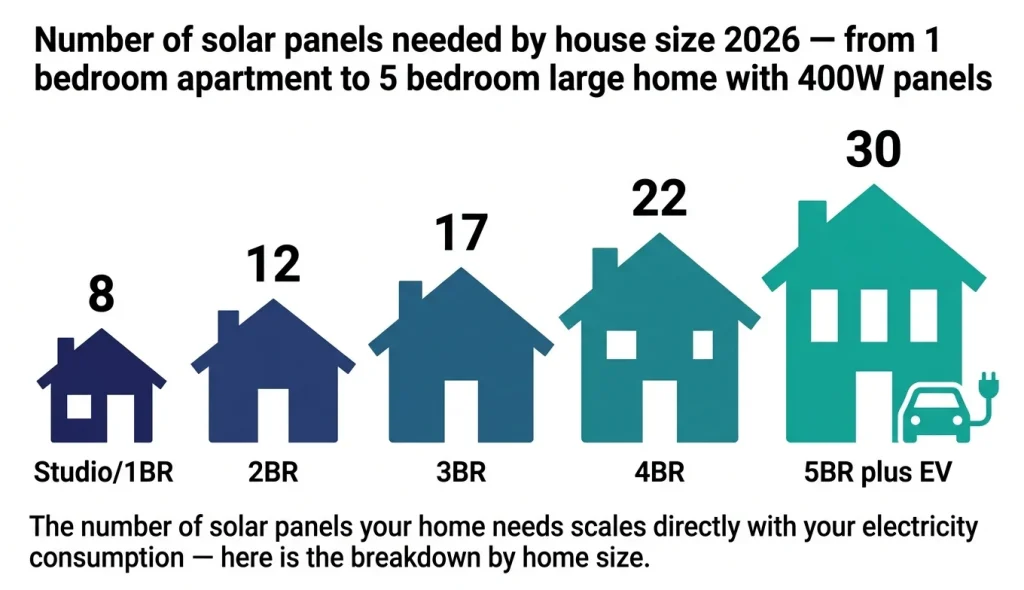
| Home Size | Avg. Monthly Usage | System Size Needed | No. of 400W Panels | Roof Space Needed | Annual Savings (avg) |
| Studio / 1BR | 350–500 kWh | 2.5–3.5 kW | 7–9 panels | 14–18 m² | $560–$840/yr |
| 2-Bedroom | 500–700 kWh | 3.5–5 kW | 9–13 panels | 18–26 m² | $840–$1,260/yr |
| 3-Bedroom (avg US) | 700–1,100 kWh | 5–8 kW | 13–20 panels | 26–40 m² | $1,260–$2,100/yr |
| 4-Bedroom | 1,100–1,500 kWh | 8–11 kW | 20–28 panels | 40–56 m² | $2,100–$2,800/yr |
| 5-Bedroom+ | 1,500–2,000 kWh | 11–14 kW | 28–35 panels | 56–70 m² | $2,800–$3,600/yr |
| 4-BR + Electric Vehicle | 1,500–2,200 kWh | 11–16 kW | 28–40 panels | 56–80 m² | $2,800–$4,000/yr |
| 4-BR + Pool | 1,600–2,400 kWh | 12–17 kW | 30–43 panels | 60–86 m² | $3,000–$4,200/yr |
Roof space figures assume standard 400W panels at approximately 2.0 m² each (21.5 sq ft). Annual savings figures based on US average electricity rate of 16¢/kWh and average sun hours of 4.5/day. Actual savings vary significantly by location.
📊 NREL: National Renewable Energy Laboratory — Residential Solar System Sizing Guidelines 2026
The 3-Step Calculation: How to Work Out Exactly How Many Panels You Need
You do not need specialist knowledge to calculate your own panel requirement. The process has three steps and requires only your electricity bill and your postcode. Here is the complete method:
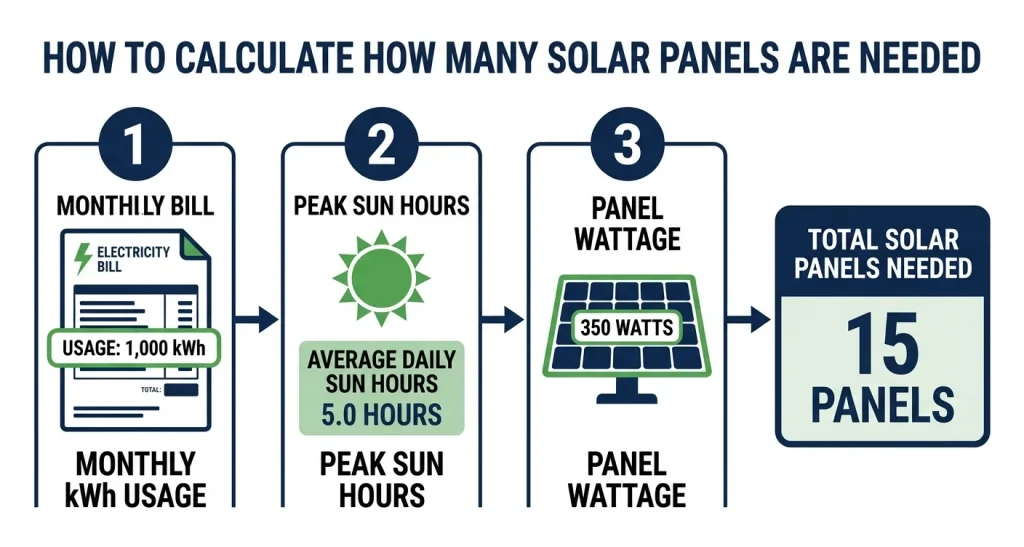
Step 1 — Find Your Monthly Electricity Consumption in kWh
Your electricity bill shows your monthly consumption in kilowatt-hours (kWh). This is distinct from the dollar amount — look for a line on your bill that reads ‘Total kWh used’ or ‘Energy consumed’. The US national average is approximately 900 kWh per month, but this varies widely:
- Hot climate homes with heavy air conditioning (Texas, Florida in summer): 1,200–1,800 kWh/month
- Temperate climate homes (Pacific Northwest, Northern states): 600–900 kWh/month
- Small apartments or energy-efficient homes: 300–500 kWh/month
- Homes with electric vehicles: add 300–500 kWh/month for the EV
- Homes with pools: add 150–300 kWh/month for the pump
Use an annual average rather than a single month — your consumption varies seasonally, and sizing your system to your annual average (rather than a summer peak) usually produces the best economics.
Step 2 — Find Your Local Peak Sun Hours
Peak sun hours are the number of hours per day your location receives sunlight of sufficient intensity for optimal solar panel output. They are not the same as daylight hours — a cloudy region might have 10 hours of daylight but only 3 peak sun hours. Here are the key figures for major US markets:
| Location | Peak Sun Hours/Day | Relative Generation |
| Arizona, Nevada, New Mexico | 5.5–6.5 hrs | ⭐⭐⭐⭐⭐ Excellent |
| California, Hawaii | 5.0–6.0 hrs | ⭐⭐⭐⭐⭐ Excellent |
| Florida, Texas, Colorado | 4.5–5.5 hrs | ⭐⭐⭐⭐ Very Good |
| New York, Georgia, Illinois | 4.0–4.5 hrs | ⭐⭐⭐ Good |
| Pacific Northwest, Michigan | 3.5–4.0 hrs | ⭐⭐⭐ Moderate |
| UK (average) | 2.5–3.2 hrs | ⭐⭐ Lower — larger system needed |
| Canada (most regions) | 3.0–4.5 hrs | ⭐⭐–⭐⭐⭐ Varies widely |
| Australia (most regions) | 4.5–6.0 hrs | ⭐⭐⭐⭐⭐ Excellent |
Step 3 — Apply the Formula
Once you have your monthly consumption and your peak sun hours, the panel count formula is:
| Number of Panels = Monthly Usage (kWh) ÷ (Peak Sun Hours × 30 days × Panel Wattage in kW × 0.80) |
The 0.80 factor accounts for system efficiency losses — inverter conversion, wiring resistance, and temperature-related output reduction. Real-world systems typically operate at 75–85% of their rated capacity; 80% is the standard planning figure.
Worked Example — 3-Bedroom Home in Texas
| Input | Value |
| Monthly electricity usage | 950 kWh/month |
| Location | Dallas, Texas |
| Peak sun hours | 5.5 hours/day |
| Panel wattage | 400W (0.4 kW) |
| System efficiency factor | 0.80 |
| Panels needed | 950 ÷ (5.5 × 30 × 0.4 × 0.80) = 950 ÷ 52.8 = 18 panels |
| System size | 18 × 400W = 7,200W = 7.2 kW |
| Estimated annual generation | 7.2 kW × 5.5 hrs × 365 × 0.80 = 11,577 kWh |
| Annual usage | 950 × 12 = 11,400 kWh |
| Coverage | 101% — fully covering annual usage |
This Dallas household needs approximately 18 panels rated at 400W to cover 100% of their annual electricity consumption. Note that the system is sized to annual totals — in winter months it may slightly under-produce, while in summer it will over-produce and generate net metering credits.
How Panel Wattage Affects the Number of Panels You Need
One reason solar quotes vary so dramatically in panel count is that different installers use panels of different wattages. The total energy your system needs to produce stays the same — but higher-wattage panels mean fewer panels needed, while lower-wattage panels mean more panels for the same output.
| Panel Wattage | Panels for 900 kWh/mo (avg US home) | Roof Space Required | Typical Tier | Notes |
| 250W | 28 panels | 56 m² | Budget/Older | More panels, lower cost per panel |
| 300W | 23 panels | 46 m² | Standard | Common in older installations |
| 350W | 20 panels | 40 m² | Mid-range | Good balance of cost and space |
| 400W | 18 panels | 36 m² | Premium | Most common new installation 2026 |
| 440W | 16 panels | 32 m² | High-efficiency | Less panels, ideal for limited roof |
| 500W+ | 14 panels | 28 m² | Ultra-premium | Best for small roofs or high shade |
In 2026, 400W panels have become the standard for new residential installations in most US markets. If your installer quotes a significantly different panel count from another company, ask them to specify the panel wattage before comparing numbers — the difference is almost always wattage, not a measurement of system quality.
📊 DOE: U.S. Department of Energy — How Solar Panels Work and How to Choose the Right System
How Many Solar Panels for Specific High-Usage Scenarios
Standard household calculators assume average usage. But several common appliances and lifestyle factors significantly increase electricity consumption — and therefore the number of panels you need. Here is how specific high-usage scenarios affect your system size:
Electric Vehicle (EV) Charging at Home
Home EV charging is one of the most common reasons homeowners need to upsize their solar system. A typical EV driven 12,000 miles per year requires approximately 3,600 kWh of electricity — adding 300 kWh per month to your home consumption.
| Scenario | Additional Monthly Usage | Extra Panels Needed (400W, 4.5 sun hrs) |
| 1 EV, average 12,000 miles/yr | ~300 kWh/month | 4–5 extra panels |
| 2 EVs, both driven regularly | ~600 kWh/month | 8–10 extra panels |
| EV + Level 2 charger (DCFC) | ~400 kWh/month | 5–7 extra panels |
Swimming Pool
A standard residential swimming pool pump running 8 hours per day consumes approximately 150 to 300 kWh per month depending on pump size and season. A heated pool can add significantly more. Pool owners typically need 2 to 5 additional panels beyond their household baseline.
Home Office with Multiple Workstations
A full home office setup with two monitors, desktop computers, and ancillary equipment running 8 hours per day adds approximately 100 to 200 kWh per month — requiring 1 to 3 additional panels. For households that transitioned to permanent remote work, this can be a significant and underestimated addition.
Air Conditioning in Hot Climates
Homes in Texas, Florida, Arizona, and similar hot climates can see electricity consumption spike to 1,500 to 2,500 kWh per month in peak summer. While the annual average is more moderate, it is worth sizing your system to at least partially address peak summer loads — particularly if your utility uses time-of-use pricing that charges premium rates during peak cooling hours.
Does Your Roof Have Enough Space for the Panels You Need?
Knowing how many panels you need is one half of the equation. The other half is whether your roof can physically accommodate them. Here is the practical roof space guide for 2026:
| Panel Count | System Size | Roof Space Needed | Minimum Roof Size (usable) |
| 10 panels | 4 kW | 20 m² (215 sq ft) | 40 m² usable roof area |
| 15 panels | 6 kW | 30 m² (323 sq ft) | 60 m² usable roof area |
| 20 panels | 8 kW | 40 m² (430 sq ft) | 80 m² usable roof area |
| 25 panels | 10 kW | 50 m² (538 sq ft) | 100 m² usable roof area |
| 30 panels | 12 kW | 60 m² (646 sq ft) | 120 m² usable roof area |
| 35 panels | 14 kW | 70 m² (753 sq ft) | 140 m² usable roof area |
‘Usable roof area’ accounts for the fact that not all roof space is accessible — setback requirements from edges and ridges (typically 300mm to 600mm), chimney and vent exclusion zones, and any shaded areas typically reduce your effective installation area by 30 to 50% of total roof area.
- A home with 200 m² total roof area might have only 80–100 m² of usable south-facing panel space after setbacks and obstructions
- If your roof cannot fit your ideal panel count, consider higher-wattage panels (440W or 500W) which generate more power per unit of roof space
- Alternatively, consider a ground-mounted system if your property has suitable land — these can be oriented and angled optimally regardless of roof orientation
How Many Solar Panels by Country — International Comparison
Because peak sun hours vary so dramatically by country, the same household needs different numbers of panels depending on where it is located — even at identical electricity consumption. Here is how a 900 kWh/month household (approximate US average) would be sized in different countries:
| Country | Peak Sun Hrs | Panels Needed (400W) | System Size | Annual Output | Covers Usage? |
| Arizona, USA | 6.5 hrs | 14 panels | 5.6 kW | 13,188 kWh | ✅ 122% |
| California, USA | 5.8 hrs | 16 panels | 6.4 kW | 13,405 kWh | ✅ 124% |
| Texas, USA | 5.5 hrs | 18 panels | 7.2 kW | 13,104 kWh | ✅ 121% |
| New York, USA | 4.5 hrs | 21 panels | 8.4 kW | 12,398 kWh | ✅ 115% |
| London, UK | 2.8 hrs | 32 panels | 12.8 kW | 11,878 kWh | ✅ 110% |
| Sydney, Australia | 5.3 hrs | 18 panels | 7.2 kW | 12,631 kWh | ✅ 117% |
| Toronto, Canada | 3.8 hrs | 25 panels | 10 kW | 12,410 kWh | ✅ 115% |
| Madrid, Spain | 5.2 hrs | 18 panels | 7.2 kW | 12,441 kWh | ✅ 115% |
The London example is striking — to cover the same 900 kWh/month consumption, a UK homeowner needs 32 panels (12.8 kW system) compared to just 14 panels in Arizona. This is why UK installation costs per covered kWh are significantly higher, and why UK solar relies more on the economics of high electricity rates rather than abundant sun.
📊 EnergySage: EnergySage — How Many Solar Panels Do I Need? Complete Guide 2026
Should You Size for 80%, 100%, or 120% of Your Electricity Usage?
A common question is whether to size your system to exactly cover your usage — or to size it slightly over or under. There is no universally right answer, but here is the practical framework:
Sizing for 80% Coverage — When It Makes Sense
Some homeowners deliberately size their system to cover 80% of their usage rather than 100%. This reduces upfront cost and may be appropriate if your utility has unfavourable net metering (paying significantly below retail rate for exported electricity), your roof space is limited, or you plan to increase electricity usage in the future (EV purchase, home extension) and want to stay within your current installation.
Sizing for 100% Coverage — The Most Common Choice
Most homeowners size to cover 100% of their annual electricity usage. This maximises the amount of expensive grid electricity you replace with cheaper solar generation, and in strong net metering markets, any excess production earns credits that offset any remaining grid usage. The 18-panel Dallas example above is a 100% coverage system.
Sizing for 110–120% — Worth Considering If You Plan to Add an EV
If you are planning to purchase an electric vehicle within the next 2 to 3 years, or are considering other high-consumption additions like a heat pump, sizing your system slightly larger than your current usage is often cost-effective. The marginal cost of adding 2 to 4 extra panels during installation is far lower than the cost of a system upgrade later — which involves additional labour, permitting, and potential inverter replacement.
Frequently Asked Questions
How many solar panels does the average house need?
The average US house consumes approximately 900 kWh per month and needs 15 to 20 solar panels rated at 400W to cover that usage, depending on location. In sun-rich states like Arizona and California, 14 to 16 panels are sufficient. In lower-sun states or for larger homes, 20 to 28 panels may be needed. Our panel count calculator gives you a precise figure based on your actual consumption and postcode.
Can 10 solar panels power a house?
Ten 400W solar panels produce a 4 kW system — sufficient to cover roughly 50 to 70% of a typical US home’s electricity needs depending on location. For a small apartment or very energy-efficient home consuming under 500 kWh per month, 10 panels could cover 80 to 100% of usage. For an average-size US home, 10 panels is a partial system that will meaningfully reduce your bill but not eliminate it entirely.
How many solar panels do I need for an EV and a house?
Adding one EV driven approximately 12,000 miles per year adds roughly 300 kWh per month to your household consumption — requiring an additional 4 to 5 panels (400W) in most US locations. A household with one EV typically needs 20 to 30 panels total depending on home size and location. Two EVs would add 8 to 10 additional panels beyond the household baseline.
Does the number of panels change if I use a battery?
Adding a battery does not directly change the number of panels you need — the system still needs to generate enough electricity to cover your usage. However, battery storage allows you to maximise the value of your generation by storing midday surplus for evening use rather than exporting it. If you are in an area with poor net metering (low export rates), pairing battery storage with a slightly smaller system can sometimes deliver better economics than a larger system with full export.