
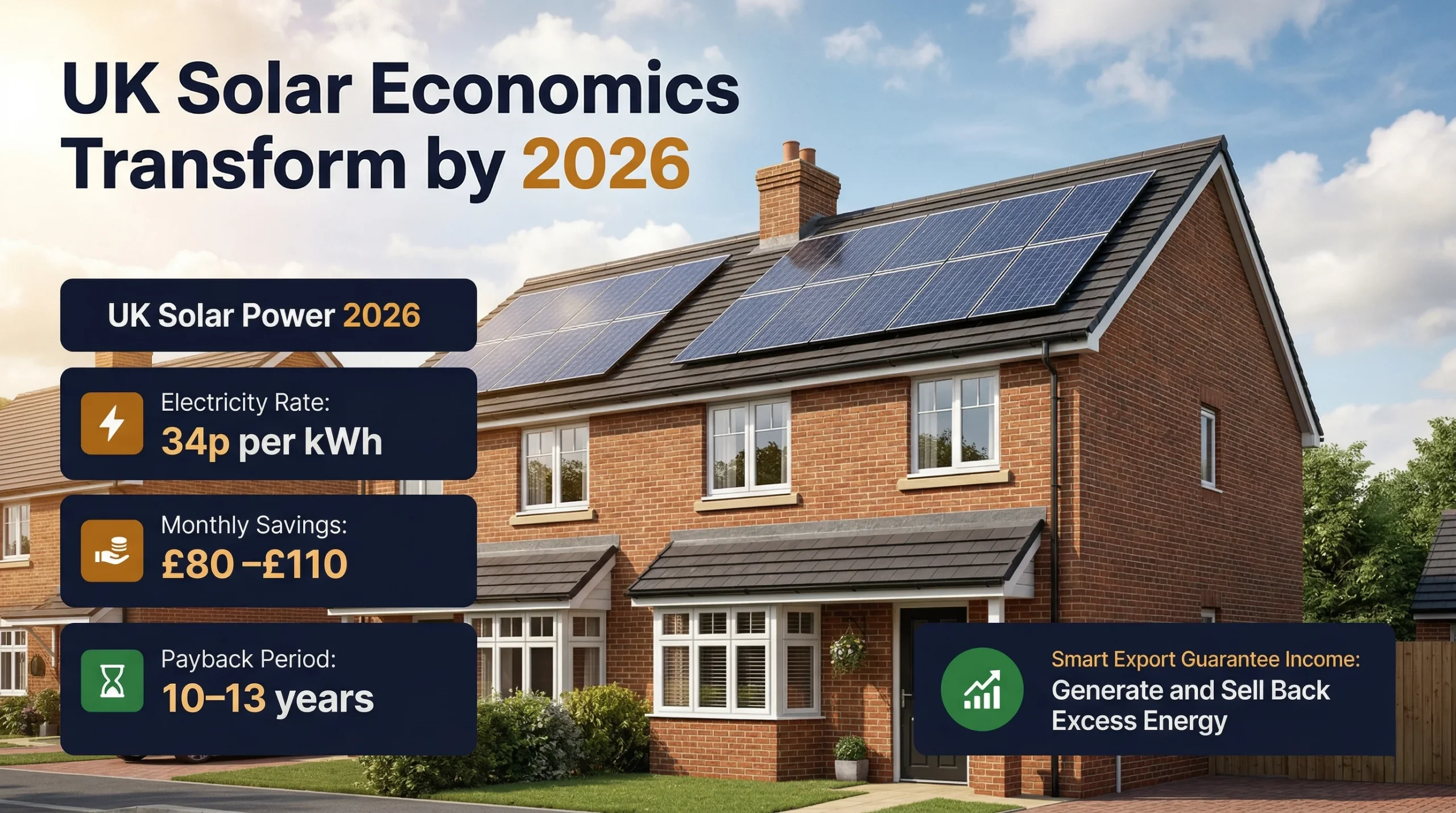
The UK solar market in 2026 looks fundamentally different from what it was in 2019. After two decades of modest adoption driven by feed-in tariff subsidies that have now expired, UK solar is growing rapidly on financial merit alone — driven by electricity prices that have settled at 34p/kWh following the 2022 energy crisis, compared to 16p/kWh before 2021. That near-doubling of electricity costs has transformed solar from a marginal investment to a financially compelling one for most UK homeowners with a south-facing roof.
The UK has also eliminated VAT on residential solar installations since April 2022 — an effective 20% reduction in installation costs. The Smart Export Guarantee (SEG) ensures that all UK homeowners with solar can earn money for surplus electricity they export to the grid. And UK panel and inverter pricing has stabilised at competitive levels after the supply chain disruptions of 2022 and 2023.
This guide gives UK homeowners the complete, honest picture: installation costs by system size, savings by region, the best SEG rates in 2026, and what solar genuinely delivers over a 25-year period on a British roof.
UK Solar 2026 — The Bottom Line:
| A 4kW solar system costs £5,500 to £8,000 installed (zero VAT) and saves £80 to £120 per month on electricity bills in 2026. The Smart Export Guarantee adds £80 to £300 per year in export income depending on your supplier choice. Payback ranges from 10 years in South England to 13 years in Scotland. The post-payback period of 12 to 15 years delivers the bulk of lifetime financial returns — making solar a sound long-term investment for most UK homeowners. |
📌 Also Read:
| → How Much Do Solar Panels Save? — UK Data → Are Solar Panels Worth It in 2026? — UK Rated ⭐⭐⭐ → Is Solar Worth It In My Area? — UK Section |
How Much Do Solar Panels Cost in the UK in 2026?
UK solar installation prices have stabilised since the 2022 to 2023 supply chain disruptions. A 4kW system — the most common residential size for a 3-bedroom UK home — costs £5,500 to £8,000 installed including all labour, scaffolding, MCS certification, and a quality string inverter. Zero VAT applies to all domestic solar installations in the UK since April 2022.
| System | Installed Cost | Monthly Saving | Annual Saving | Payback | 25-Year Return |
| 3 kW | £4,500–£6,500 | £60–£85/mo | £720–£1,020 | 9–11 yrs | £11,500–£16,500 |
| 4 kW | £5,500–£8,000 | £80–£115/mo | £960–£1,380 | 10–12 yrs | £15,000–£22,000 |
| 5 kW | £7,000–£10,000 | £95–£130/mo | £1,140–£1,560 | 10–13 yrs | £18,000–£25,000 |
| 6 kW | £8,500–£12,000 | £110–£150/mo | £1,320–£1,800 | 11–14 yrs | £21,000–£29,000 |
| 4kW + 5kWh battery | £9,000–£13,000 | £100–£135/mo | £1,200–£1,620 | 11–14 yrs | £18,000–£26,000 |
Always use an MCS (Microgeneration Certification Scheme) certified installer — required for Smart Export Guarantee eligibility. Installation costs include an MCS certificate which documents your system for any future property sale. The zero VAT rate applies only to residential installations by MCS-certified installers.
Smart Export Guarantee (SEG) — Getting Paid for Surplus Solar
The Smart Export Guarantee requires all UK licensed electricity suppliers with 150,000+ customers to offer export tariffs for residential solar. Unlike the old Feed-in Tariff (which ended for new applicants in March 2019), the SEG does not guarantee a specific rate — suppliers set their own rates, creating a market where your choice of supplier meaningfully affects your solar income.
| Supplier | SEG Rate (2026) | Annual Income (4kW, 40% exported) | Notes |
| Octopus Energy (Outgoing) | Up to 15p/kWh | ~£280/yr | Consistently market-leading rate |
| EDF Energy | 7.5p/kWh | ~£140/yr | Standard SEG offer |
| British Gas | 5.5p/kWh | ~£103/yr | Standard SEG offer |
| E.ON Next | 5.5p/kWh | ~£103/yr | Standard SEG offer |
| Scottish Power | 5.0p/kWh | ~£94/yr | Standard SEG offer |
| Bulb / Octopus tariffs | Variable | Varies | Smart meter time-varying options |
The difference between Octopus Energy’s 15p SEG and a 5p competitor is approximately £180 per year on a 4kW system. Over a 25-year system life, that adds up to nearly £4,500 in additional income — a material difference that justifies switching supplier purely for the SEG rate. You can switch SEG provider independently of your import tariff with most suppliers.
UK Solar Savings by Region — How Location Affects Your Returns
| UK Region | Sun Hrs/day | Annual Gen. (4kW) | Monthly Saving | Payback |
| South England (Kent, Sussex, Devon) | 3.2 hrs | 4,678 kWh | £110–£140/mo | 9–11 yrs |
| London | 3.0 hrs | 4,380 kWh | £100–£130/mo | 10–12 yrs |
| Midlands (Birmingham, Nottingham) | 2.9 hrs | 4,234 kWh | £100–£125/mo | 10–12 yrs |
| Yorkshire / North England | 2.7 hrs | 3,942 kWh | £90–£115/mo | 11–13 yrs |
| Wales | 2.6 hrs | 3,796 kWh | £85–£110/mo | 11–13 yrs |
| Scotland (Lowlands) | 2.4 hrs | 3,504 kWh | £78–£100/mo | 12–14 yrs |
Even Scotland’s more modest sun hours — at 2.4 hours per day — deliver positive long-term solar returns at 34p/kWh. A Scottish household generating 3,504 kWh per year from a 4kW system saves approximately £1,191 in electricity costs annually. With a system cost of £6,000 to £7,500, payback occurs in 12 to 14 years — leaving 11 to 13 years of pure profit within the 25-year warranty period. Solar is financially worthwhile across the whole of the UK in 2026.
UK Solar Incentives in 2026
- Zero VAT: all domestic solar installations are zero-rated for VAT since April 2022 — an effective 20% reduction in installation cost vs the pre-April 2022 standard rate. This is automatic and applied by your installer.
- Smart Export Guarantee: as detailed above — guaranteed export payments from licensed suppliers. MCS certification required.
- No council tax uplift: solar panels do not trigger a council tax revaluation in England, Scotland, or Wales.
- Property value increase: studies from Nationwide and Halifax show solar panels increase UK property values by 4 to 8% — typically £12,000 to £25,000 on an average UK home.
- ECO4 scheme: for eligible fuel-poor households, the Energy Company Obligation (ECO4) can fund solar installations at zero cost. Check eligibility at your local council.
- Great British Insulation Scheme: though focused on insulation, reducing your home’s energy demand increases the effective value of your solar generation.
📌 Also Read:
| → How Long to Pay Off Solar Panels? — UK Payback Data → How Much Do Solar Panels Cost Per Month? Finance Options → Average Solar Panel Savings Per Month — UK Included |
Frequently Asked Questions — UK Solar 2026
Are solar panels worth it in the UK in 2026?
Yes — for most UK homeowners with a south or southwest-facing roof and a monthly electricity bill above £80. The transformation of UK electricity prices since 2021 (from 16p to 34p/kWh) has roughly halved the payback period from pre-crisis levels. South England achieves 10 to 11 year paybacks; Scotland 12 to 14 years. Given 25-year warranties, even Scotland delivers a strongly positive long-term financial return.
What SEG rate should I look for in 2026?
Octopus Energy’s Outgoing Octopus tariff consistently offers the highest SEG rate in the UK — up to 15p/kWh in 2026. This is 3x the 5p rate offered by many standard suppliers. For a 4kW system in South England exporting approximately 1,800 kWh per year, the difference is £180 per year. Always switch your SEG provider to the best available rate before your first bill — it takes about 10 minutes online.
Do I need planning permission for solar panels in the UK?
In most cases no — residential solar installations benefit from permitted development rights in England, Scotland, and Wales. Exceptions: listed buildings (listed building consent required), properties in conservation areas (may be restricted), and systems that protrude more than 200mm from the roof pitch or rise above the roof ridge. Always confirm with your local planning authority if uncertain, and verify your installer has checked permitted development compliance before proceeding.
How long does solar installation take in the UK?
A standard 4kW residential solar installation in the UK typically takes 1 to 2 days of physical work. The overall project timeline from contract to commissioning is usually 2 to 6 weeks — primarily waiting for scaffolding availability, grid notification processing (required for systems over 3.68kW), and MCS documentation completion. Your installer should handle all notifications to your distribution network operator (DNO) as part of the installation service.