
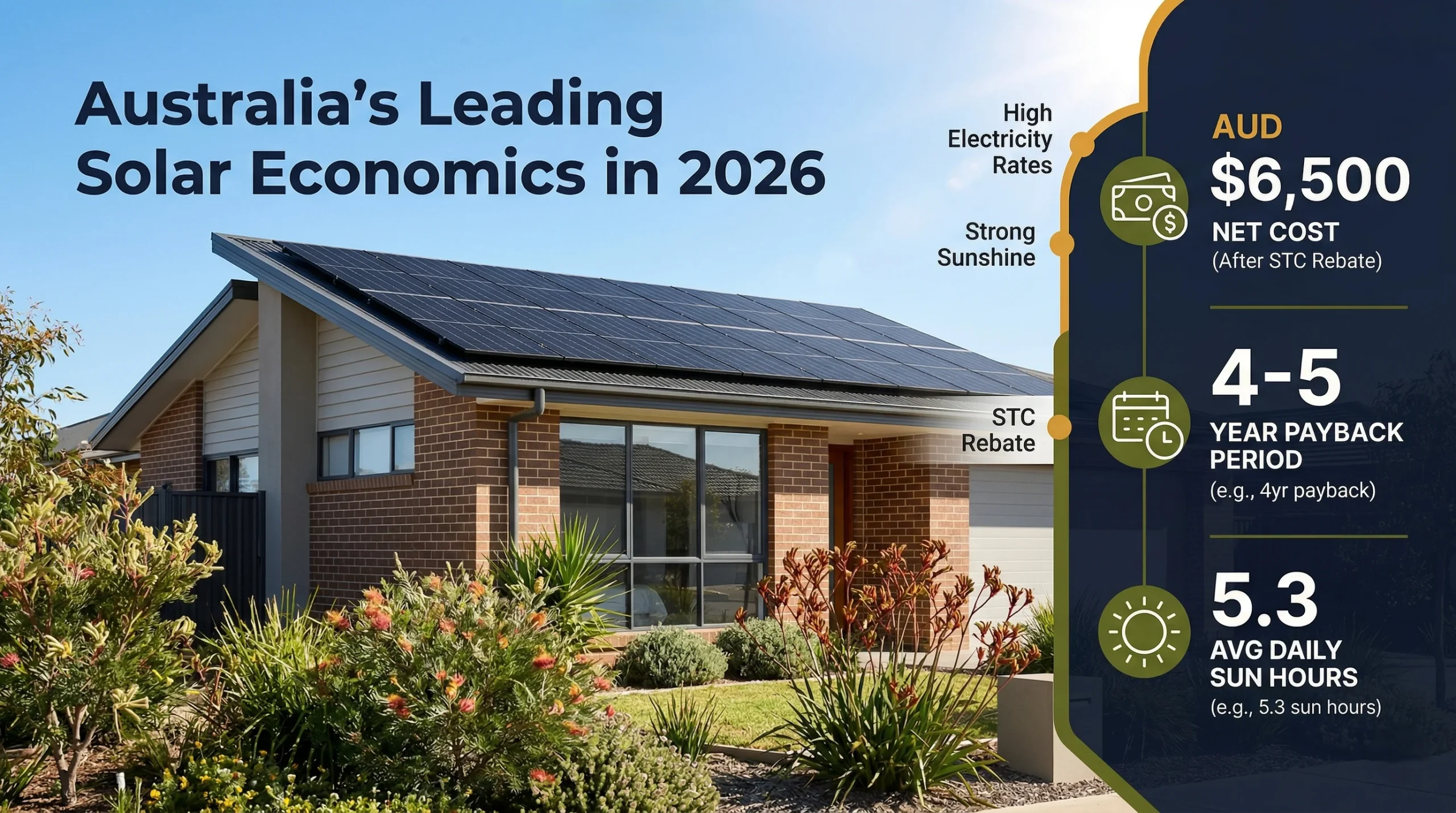
Australia is the undisputed global leader in residential solar uptake — and in 2026, it remains the world’s most compelling solar market by almost every financial measure. More than 3.6 million Australian homes now have rooftop solar, representing approximately one in three homes with a suitable roof. This scale has created a mature, intensely competitive installer market where quality 6.6kW systems (the most popular size) install for as little as AUD $5,000 to $8,500 after the government’s Small-scale Technology Certificate (STC) rebate.
The combination driving Australia’s exceptional solar economics: electricity rates that now average 28 to 40¢ AUD per kWh depending on state and retailer, excellent sunshine across most of the country, low competitive installation costs, and the STC rebate that acts as an upfront government subsidy paid through the installer at point of sale. No application. No tax return. Just a reduced bill.
This guide covers the complete picture for Australian homeowners in 2026 — costs by system size, STC rebate explained, state-by-state data, feed-in tariff rates by retailer, and the battery storage decision.
Australian Solar 2026 — The World’s Best ROI:
| A 6.6kW solar system costs AUD $5,000 to $8,500 net after the STC rebate in 2026. Annual savings range from AUD $1,800 to $2,500 depending on state and feed-in tariff. Payback periods run 3 to 6 years — among the shortest of any developed country. South Australia leads on electricity rates; Queensland leads on sun hours. Australia is objectively the world’s best residential solar market in 2026. |
📌 Also Read:
| → How Much Do Solar Panels Save? — AU Data Included → How Long to Pay Off Solar Panels? — AU Payback → Are Solar Panels Worth It in 2026? — AU Rated ⭐⭐⭐⭐⭐ |
How Much Do Solar Panels Cost in Australia in 2026?
Australian solar installation costs are among the lowest in the developed world — the result of intense market competition, high installation volumes, and the STC rebate reducing the out-of-pocket price further. The 6.6kW system is the most popular size for standard Australian homes (fitting within the standard single-phase 5kW inverter limit).
| System | Gross Cost | After STC Rebate | Monthly Saving | Annual Saving | Payback |
| 3 kW | AUD $3,800–$5,200 | AUD $2,500–$3,800 | AUD $100–$130/mo | AUD $1,200–$1,560 | 2–4 yrs |
| 5 kW | AUD $4,800–$7,000 | AUD $3,200–$5,200 | AUD $160–$200/mo | AUD $1,920–$2,400 | 2–4 yrs |
| 6.6 kW | AUD $5,500–$8,500 | AUD $3,800–$6,200 | AUD $200–$255/mo | AUD $2,400–$3,060 | 2–4 yrs |
| 10 kW | AUD $8,000–$12,500 | AUD $5,600–$9,000 | AUD $285–$345/mo | AUD $3,420–$4,140 | 3–5 yrs |
| 13.3 kW | AUD $11,000–$16,500 | AUD $7,500–$11,800 | AUD $360–$430/mo | AUD $4,320–$5,160 | 3–5 yrs |
Always use a Clean Energy Council (CEC) accredited installer — required for STC rebate eligibility. Get three quotes; price variation of 25 to 35% for equivalent quality is common. Beware of very cheap quotes using non-approved or Tier 2 panels with inferior degradation warranties.
📊 Solar Choice Australia: 2026 solar system cost benchmarks
The STC Rebate — Australia’s Solar Superpower
The Small-scale Technology Certificate (STC) scheme is Australia’s primary federal solar subsidy — and it explains why Australian installation costs are so much lower than comparable systems in the UK or US. Here is how it works in plain language:
When you install a qualifying solar system, your installer creates a number of STC certificates based on your system’s expected generation over the remaining years of the scheme (which runs to 2030). These certificates are traded on the STC market — electricity retailers buy them to meet their Renewable Energy Target obligations. Your installer sells them and passes the value to you as an upfront discount on your installation cost.
- The STC rebate is applied at the point of sale — you pay the discounted price and never need to claim anything
- Rebate values in 2026: approximately AUD $2,500 to $4,000 for a 6.6kW system depending on your zone and STC market price
- Higher solar zones (QLD, WA, NT) generate more STCs per system than lower zones (VIC, TAS) due to more expected generation
- STC values decrease each year as the scheme phases down towards 2030 — the rebate will be smaller each subsequent year
- Only CEC accredited installers using approved products are eligible to create STCs — this is why using accredited installers is essential
Solar Savings by Australian State — 2026 Data
| State | Elect. Rate | Sun Hrs | Net Cost (6.6kW) | Monthly Saving | Payback | FiT Rate (approx.) |
| QLD | 25–32¢ AUD | 5.4 hrs | AUD $4,000–$6,000 | AUD $200–$250/mo | 2–4 yrs | 6–12¢/kWh |
| NSW | 25–32¢ AUD | 4.9 hrs | AUD $4,500–$7,000 | AUD $190–$240/mo | 3–5 yrs | 5–10¢/kWh |
| VIC | 26–34¢ AUD | 4.1 hrs | AUD $4,200–$6,500 | AUD $175–$225/mo | 3–5 yrs | Up to 10¢/kWh |
| SA | 30–42¢ AUD | 5.0 hrs | AUD $4,500–$7,000 | AUD $225–$285/mo | 2–4 yrs | 5–10¢/kWh |
| WA | 25–31¢ AUD | 5.5 hrs | AUD $3,800–$6,000 | AUD $200–$255/mo | 2–4 yrs | ~3¢ (Synergy) |
| ACT | 20–26¢ AUD | 4.8 hrs | AUD $4,500–$7,000 | AUD $155–$200/mo | 3–5 yrs | Up to 17.5¢/kWh |
| TAS | 22–28¢ AUD | 3.5 hrs | AUD $4,000–$6,000 | AUD $120–$155/mo | 4–6 yrs | ~6¢/kWh |
South Australia’s electricity rates — which have exceeded 42¢/kWh in peak tiers for some customers — make it one of the world’s highest-value solar markets. The ACT’s excellent feed-in tariff of up to 17.5¢/kWh through ActewAGL provides exceptional export compensation compared to other states. Western Australia’s Synergy offers a very low feed-in rate (~3¢/kWh) — making self-consumption maximisation and battery storage especially important for WA households.
Feed-in Tariffs in Australia 2026 — What Your Exports Are Worth
Australia uses feed-in tariffs (FiTs) rather than US-style net metering. When your solar panels produce more than your home uses, the surplus exports to the grid and you receive a per-kWh payment from your electricity retailer. Current 2026 FiT rates are significantly below the import rate — making self-consumption the financial priority:
- QLD: 6–12¢/kWh typical across major retailers (Origin, AGL, Energex/Ergon)
- NSW: 5–10¢/kWh typical across Ausgrid and Endeavour Energy retailers
- VIC: 5–10¢/kWh — some plans offer higher peak-hour FiTs through the Victorian DER programme
- SA: 5–10¢/kWh — SA Power Networks retailers. Some time-varying plans pay more during peak demand
- ACT: Up to 17.5¢/kWh (ActewAGL Eligible Solar Program) — Australia’s best FiT
- WA (Synergy): approximately 3¢/kWh — deliberately low to encourage self-consumption and battery storage
The gap between import rate (28–40¢) and export rate (3–17¢) means each exported kWh earns 40 to 90% less than each self-consumed kWh. Shifting appliance usage to solar hours and adding battery storage are the primary strategies to maximise solar financial returns in all Australian states.
Battery Storage in Australia — When Does It Make Sense?
With low FiTs (especially in WA and QLD), battery storage has strong financial justification for many Australian households in 2026. Converting a 3 to 6¢ export into a 28 to 32¢ import avoided is a 5x to 10x improvement in value per kWh. State battery incentive programmes further improve the economics:
- Victoria: Solar Homes Programme interest-free battery loan up to AUD $8,800 for qualifying households
- South Australia: Home Battery Scheme — rebates up to AUD $2,000
- ACT: Sustainable Household Scheme — zero-interest loans for batteries
- NSW: Empowering Homes interest-free loan — up to AUD $14,000 for solar+battery systems for qualifying households
📌 Also Read:
| → Are Solar Panels Worth It in 2026? — AU Rated ⭐⭐⭐⭐⭐ → How Much Do Solar Panels Cost Per Month? — Finance Options → How Many Solar Panels to Power a House? — AU Context |
Frequently Asked Questions — Australian Solar 2026
How much does a solar system cost in Australia after the STC rebate?
After the STC rebate, a 6.6kW solar system costs approximately AUD $4,000 to $7,000 in 2026 depending on your state, installer quality, and panel brand. Queensland and WA are typically cheapest. South Australia and NSW mid-range. Premium systems with top-tier panels (SunPower, REC, Panasonic) cost more but offer better efficiency, warranty terms, and degradation rates.
What is the solar payback period in Australia in 2026?
Australia has the world’s shortest residential solar payback periods — typically 3 to 5 years for a 6.6kW system in most states. Queensland and South Australia achieve 3 to 4 year paybacks. Victoria and Tasmania see 4 to 6 years due to lower sun hours. After payback, the system continues generating free electricity for 20+ additional years.
How do I choose a solar installer in Australia?
Use only Clean Energy Council (CEC) accredited installers — required for STC eligibility and minimum quality assurance. Verify the installer’s workmanship warranty (minimum 5 years), check product approvals using the CEC’s approved product list, and compare three quotes through platforms like Solar Choice or the CEC’s installer search. The CEC accreditation programme is Australia’s primary quality standard for solar installers.
Does Australia have a tax credit like the US federal ITC?
No — Australia’s primary federal incentive is the STC rebate scheme applied at point of sale, not a tax credit. Several state governments offer additional battery rebates and interest-free loans. The combined financial effect of the STC rebate plus any applicable state programme is often comparable to or greater than the US 30% ITC in effective dollar terms, particularly in high-zone states like Queensland and Western Australia.