
North Island, Nelson-Marlborough, and the Bay of Plenty, where annual sunshine hours rival parts of Southern Europe.
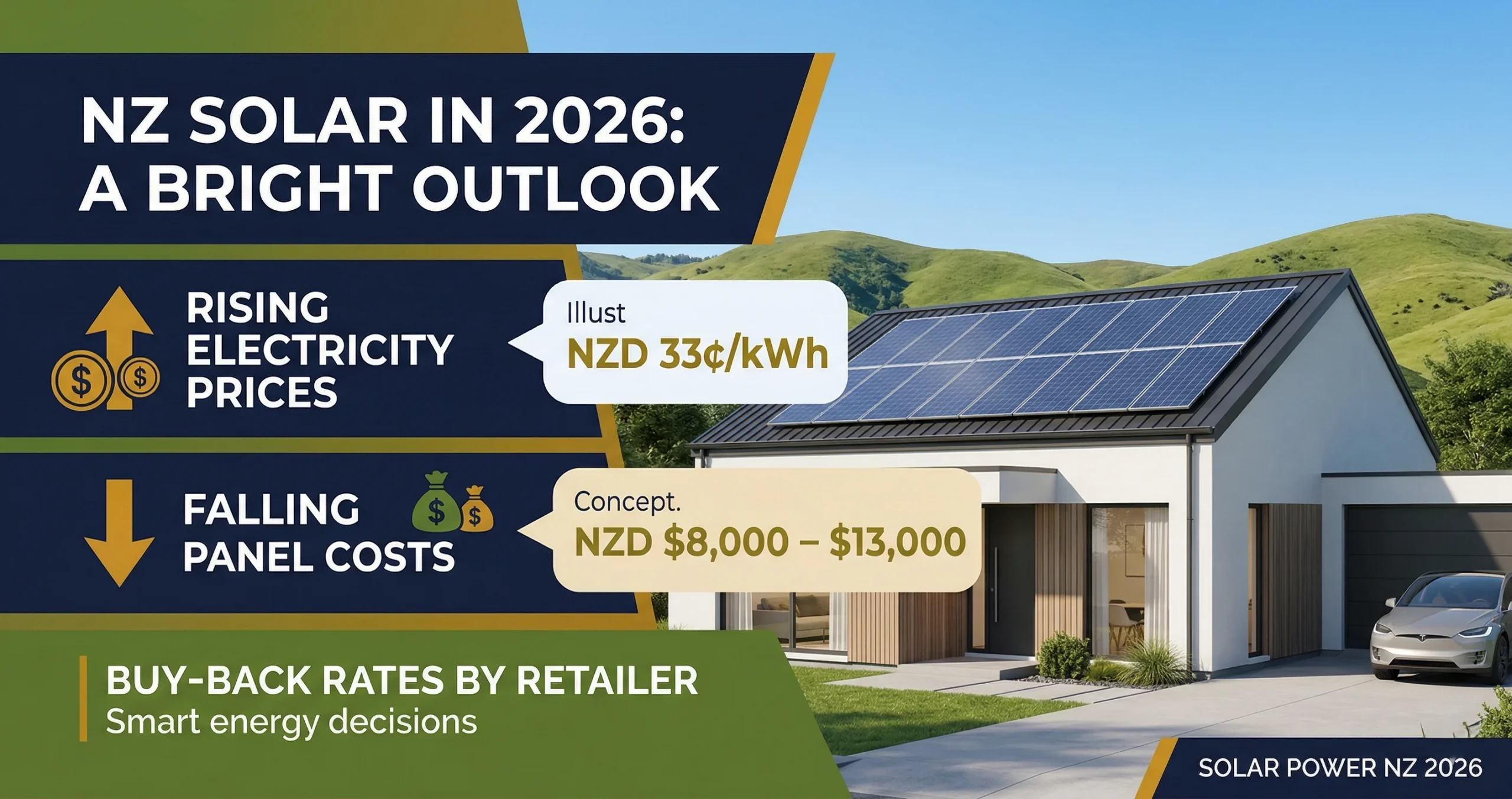
The honest context: unlike Australia, New Zealand does not have a national solar rebate programme. There are no federal tax credits for solar. Buy-back rates from electricity retailers for exported solar electricity are generally low — typically 5 to 12¢ NZD per kWh against import rates of 33 to 38¢. This means the financial case for NZ solar depends heavily on self-consumption rate and local sun hours, rather than favourable government incentive stacks.
For the right household — one that is home during the day, has high electricity consumption, or can charge an EV from solar — the numbers work clearly. For a household that exports most of its generation, the economics are more marginal. This guide gives New Zealand homeowners the honest, complete picture.
New Zealand Solar 2026 — The Bottom Line:
| A 5kW solar system in New Zealand costs NZD $8,000 to $13,000 installed — no government rebate reduces this cost. Annual savings range from NZD $1,200 to $2,100 depending on location and self-consumption rate. Payback periods run 8 to 12 years. Nelson and the upper North Island achieve the fastest paybacks. Self-consumption optimisation and buy-back tariff selection are critical financial levers for NZ solar owners. |
📌 Also Read:
| → Is Solar Worth It In My Area? — NZ Section → How Much Do Solar Panels Save? — NZ Data Included → Are Solar Panels Worth It in 2026? |
How Much Do Solar Panels Cost in New Zealand in 2026?
NZ solar installation costs have fallen significantly over the past five years and now sit at competitive levels relative to Australia. Unlike Australia, there is no government rebate that reduces the price at point of sale — the costs below are the actual prices you pay.
| System | Installed Cost (NZD) | Monthly Saving | Annual Saving | Payback | 25-Yr Return |
| 3 kW | NZD $5,500–$8,500 | NZD $65–$95/mo | NZD $780–$1,140 | 7–10 yrs | NZD $14,000–$21,000 |
| 5 kW | NZD $8,000–$13,000 | NZD $100–$145/mo | NZD $1,200–$1,740 | 8–12 yrs | NZD $22,000–$34,000 |
| 6.6 kW | NZD $10,000–$15,500 | NZD $125–$175/mo | NZD $1,500–$2,100 | 8–12 yrs | NZD $27,000–$42,000 |
| 10 kW | NZD $14,000–$21,000 | NZD $175–$245/mo | NZD $2,100–$2,940 | 8–12 yrs | NZD $40,000–$58,000 |
📊 EECA: New Zealand Solar Panel Guide and Cost Data
NZ Solar Buy-Back Rates — What Your Exported Electricity Is Worth
NZ electricity retailers are required to offer buy-back rates for solar export — but rates vary significantly. Unlike US net metering (which credits exports at close to retail rate in many states), NZ buy-back rates are well below the import rate, making every exported kWh worth 2 to 7 times less than one you consume yourself.
| Retailer | Buy-Back Rate | Import Rate | Self-Consume Value vs Export | Annual Export Income (5kW, 30% exported) |
| Contact Energy | 8–12¢ NZD | 33¢ | 2.75–4.1× more valuable to self-consume | NZD $144–$216 |
| Mercury Energy | 7–12¢ NZD | 33¢ | 2.75–4.7× more valuable | NZD $126–$216 |
| Meridian Energy | 7–10¢ NZD | 33¢ | 3.3–4.7× more valuable | NZD $126–$180 |
| Genesis Energy | 5–8¢ NZD | 33¢ | 4.1–6.6× more valuable | NZD $90–$144 |
| Flick Electric | Spot (variable) | Variable | Variable | Potentially higher in peak periods |
The message is clear: self-consumption is the primary financial strategy for NZ solar. Every kWh you consume directly from your panels at 33¢ import avoidance is worth 3 to 7 times more than one you export at 5 to 12¢ buy-back. Shifting appliance use to solar hours, adding smart home controls, and considering battery storage are the highest-impact actions for NZ solar owners.
Solar Savings by New Zealand City
| City / Region | Sunshine Hrs/yr | Monthly Saving (5kW) | Annual Saving | Payback |
| Nelson / Marlborough | 2,400–2,600 hrs | NZD $140–$175/mo | NZD $1,680–$2,100 | 7–9 yrs |
| Whangarei / Northland | 2,200–2,400 hrs | NZD $130–$165/mo | NZD $1,560–$1,980 | 8–10 yrs |
| Auckland | 2,000–2,200 hrs | NZD $120–$155/mo | NZD $1,440–$1,860 | 8–10 yrs |
| Bay of Plenty / Tauranga | 2,100–2,300 hrs | NZD $125–$160/mo | NZD $1,500–$1,920 | 8–10 yrs |
| Christchurch | 2,100–2,300 hrs | NZD $120–$155/mo | NZD $1,440–$1,860 | 8–11 yrs |
| Wellington | 1,800–2,000 hrs | NZD $105–$135/mo | NZD $1,260–$1,620 | 9–12 yrs |
| Dunedin | 1,600–1,900 hrs | NZD $90–$115/mo | NZD $1,080–$1,380 | 10–13 yrs |
Nelson’s 2,400 to 2,600 annual sunshine hours make it the solar capital of New Zealand — comparable to parts of Spain. For Nelson homeowners, the combination of excellent generation and high NZ electricity rates produces payback periods approaching 7 to 9 years without any government rebate. Auckland and the Bay of Plenty follow closely with strong economics. Wellington, despite its reputation for wind and cloud, still achieves positive long-term solar returns due to high electricity rates compensating for lower generation.
NZ Solar Incentives and Government Programmes 2026
New Zealand does not have a national solar rebate or federal tax credit programme in 2026. Available support includes:
- Kainga Ora interest-free loans: for eligible low-income owner-occupiers for renewable energy improvements including solar
- EECA HomeEnergy programme: energy advice and assessments including solar — no direct grants but facilitates access to financing
- Regional council initiatives: some regional and district councils offer local grants or rates remission for solar energy. Check with your local council for current offerings.
- Healthy Homes Investment Programme: primarily heating and insulation, but some extensions cover solar for eligible properties
- GST applies at 15%: solar installations are subject to standard GST — already included in the installer quotes above
The absence of a national rebate is the most significant difference from Australia — and the primary reason NZ installation costs are higher relative to the savings delivered than in the Australian market. NZ government policy on a national solar scheme has been discussed but not progressed to a formal programme as of 2026.
Battery Storage in New Zealand — Is It Worth It?
Given New Zealand’s low buy-back rates (5 to 12¢), battery storage has a clear financial case for many NZ solar homeowners. Converting a 7¢ export into a 33¢ import avoided is a 4.7× value improvement per kWh. Home battery systems in NZ cost NZD $12,000 to $20,000 installed for a 10kWh system. At a typical NZ electricity rate of 33¢ and assuming 2,000 kWh per year cycled through the battery, annual additional savings from storage are approximately NZD $520 — producing a standalone battery payback of 12 to 18 years. Combined with rising electricity prices, the battery economics improve each year.
📌 Also Read:
| → How Long to Pay Off Solar Panels? — NZ and International → Average Solar Panel Savings Per Month — NZ Included → How Much Do Solar Panels Cost Per Month? |
Frequently Asked Questions — New Zealand Solar 2026
Is solar worth it in New Zealand in 2026?
For most NZ homeowners in the North Island, Nelson, and Canterbury with high self-consumption rates (60%+), solar delivers a positive financial return in 2026. With electricity at 33 to 38¢ NZD/kWh and installation costs of NZD $8,000 to $13,000, payback periods are typically 8 to 12 years — leaving 13 to 17 years of profit within the warranty period. Wellington and Dunedin are more marginal due to lower sunshine but still deliver positive long-term returns. The key variable is your self-consumption rate: households home during the day see much better returns than those away all day exporting most of their generation.
Does New Zealand have solar rebates?
New Zealand does not have a national solar rebate programme as of 2026 — unlike Australia’s STC scheme. Some regional councils and Kainga Ora housing programmes offer limited grants or interest-free loans for qualifying households. The NZ government has explored a national scheme but it has not been implemented. This is the primary reason NZ installation costs are higher relative to system value than in Australia.
How do NZ buy-back rates work?
Your electricity retailer pays you a per-kWh rate for every unit of solar electricity your system exports to the grid. Rates currently range from 5¢ to 12¢ NZD per kWh — well below the 33¢ import rate. Contact Energy and Mercury currently offer the highest standard buy-back rates. You can switch to a better buy-back rate independently of your import tariff. Use the Electricity Authority’s consumer tools to compare current offers. Setting a smart export meter through your retailer is required for buy-back payment.
Can NZ solar panels power an EV efficiently?
Yes — and the economics are particularly attractive. Charging an EV from solar during the day converts solar generation worth 33¢/kWh (in import avoidance) rather than earning the 7 to 12¢ buy-back rate on that same electricity. A typical EV driven 15,000km per year uses approximately 2,250 kWh — saving NZD $743 per year at 33¢/kWh when charged from solar. For EV owners, sizing the solar system to include the EV load and scheduling charging during peak solar hours maximises both self-consumption and overall financial return.