
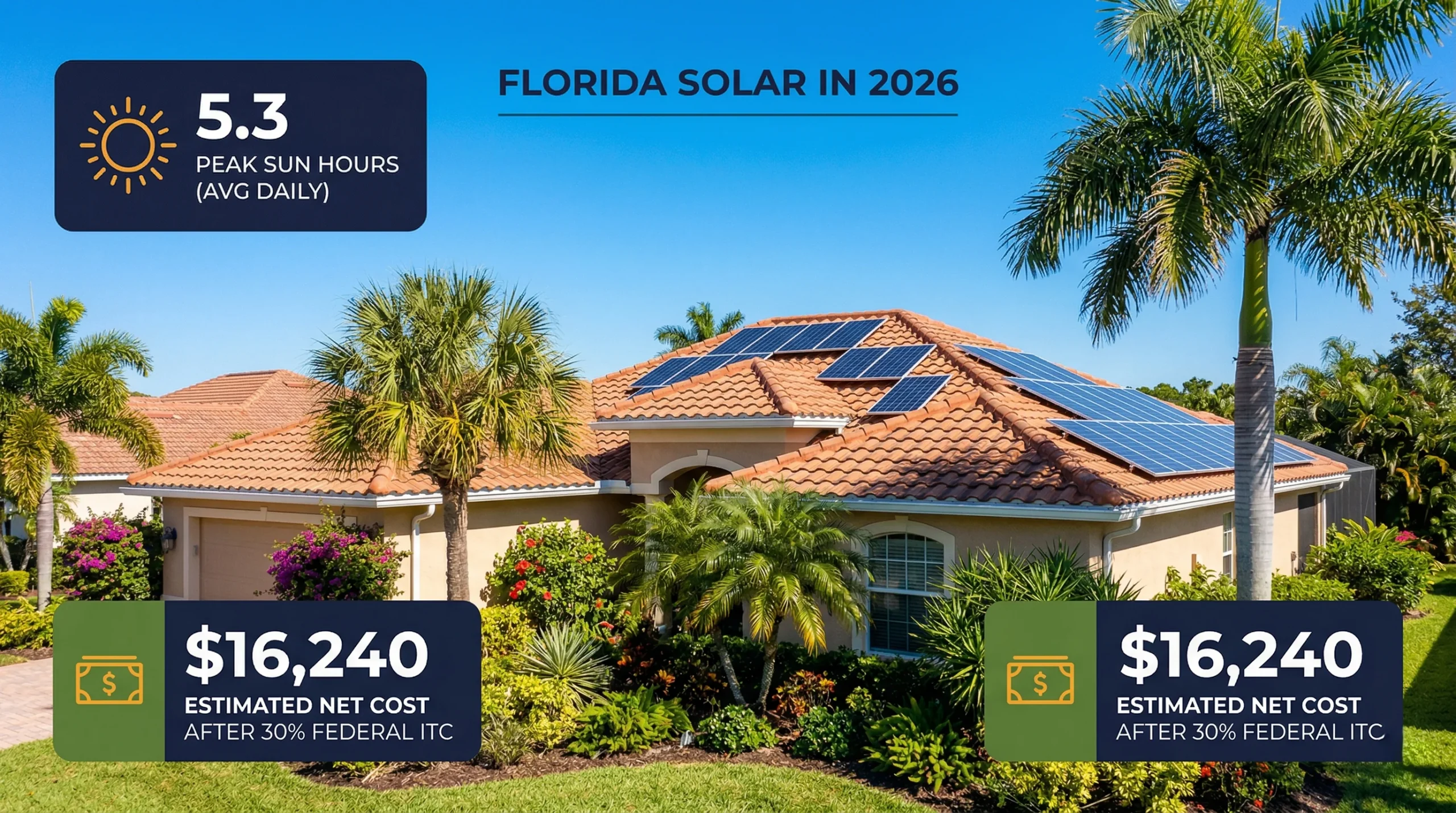
Florida earns its ‘Sunshine State’ title with approximately 230 to 260 sunny days per year and 5.3 average peak sun hours per day. Add electricity rates from Florida’s major utilities that have risen 20 to 30% since 2020, significant summer air conditioning loads that drive bills well above $200 per month for many households, and the federal 30% ITC — and Florida solar economics are strong.
The important context for 2026: Florida changed its net metering rules in 2023. Governor DeSantis signed SB 1024 in March 2023, replacing full retail net metering with ‘net billing’ for new solar installations from January 1, 2024. Under net billing, surplus electricity exported to the grid is compensated at an ‘avoided cost’ rate of approximately 10 to 11¢/kWh — below the 13¢/kWh retail import rate. For homeowners who installed before December 31, 2023, full retail net metering continues for 10 years from their installation date.
The practical impact of this change is real but moderate — and for homeowners who optimise their self-consumption, the economics remain excellent. This guide gives Florida homeowners the complete, accurate 2026 picture.
Florida Solar 2026 — The Bottom Line:
| An 8kW solar system for an average Florida home costs $15,680 to $17,920 net after the 30% ITC. Annual savings range from $1,700 to $2,300. Payback periods are 7 to 9 years. Florida’s net billing change reduced export credits slightly — but property and sales tax exemptions, abundant sunshine, and high summer electricity bills make solar a strong long-term investment for most Florida homeowners. |
📌 Also Read:
| → How Much Do Solar Panels Save? Florida State Data → Net Metering Calculator — Understanding Export Credits → Federal Solar Tax Credit: Complete 2026 Guide |
Florida Solar Costs in 2026
Florida has a competitive solar installer market — strong in Tampa Bay, Orlando, Miami-Dade, Jacksonville, and the Space Coast. In 2026, residential solar costs $2.80 to $3.20 per watt installed, slightly below the national average.
| System | Gross Cost | After 30% ITC | Monthly Saving | Annual Saving | Payback |
| 5 kW | $14,000–$16,000 | $9,800–$11,200 | $105–$135/mo | $1,260–$1,620 | 9–11 yrs |
| 6 kW | $16,800–$19,200 | $11,760–$13,440 | $125–$160/mo | $1,500–$1,920 | 8–10 yrs |
| 8 kW | $22,400–$25,600 | $15,680–$17,920 | $165–$215/mo | $1,980–$2,580 | 7–9 yrs |
| 10 kW | $28,000–$32,000 | $19,600–$22,400 | $200–$255/mo | $2,400–$3,060 | 8–10 yrs |
Florida Net Billing — What Changed in 2023 and What It Means
Under Florida’s pre-2024 net metering, surplus solar electricity was credited at the full 13¢/kWh retail import rate — dollar-for-dollar. Under net billing (applicable to systems installed after December 31, 2023), exported electricity is compensated at an ‘avoided cost’ rate of approximately 10 to 11¢/kWh for FPL and Duke Energy Florida customers.
The financial impact on a typical 8kW system that exports 30% of generation (approximately 2,300 kWh/year):
- Under net metering: 2,300 kWh × 13¢ = $299/year in export credits
- Under net billing: 2,300 kWh × 10.5¢ = $242/year in export credits
- Annual difference: approximately $57 per year — meaningful but not dramatic
Key points: Systems installed before December 31, 2023 are grandfathered on full retail net metering for 10 years from installation. The 70% of generation self-consumed is completely unaffected by the net billing change — it still saves you 13¢/kWh in import avoidance. The self-consumption value is and always was the dominant source of solar savings.
Florida Solar Savings by City and Utility
| Utility / Area | Import Rate | Export (Net Billing) | Monthly Saving (8kW) | Notes |
| FPL — Southeast FL | 13¢/kWh | 10–11¢/kWh | $165–$210/mo | Largest FL utility |
| Duke Energy Florida — Tampa/Central | 13¢/kWh | 10–11¢/kWh | $165–$210/mo | Net billing applies |
| TECO — Tampa metro | 13¢/kWh | Varies | $160–$205/mo | Check current terms |
| JEA — Jacksonville (municipal) | 12¢/kWh | Varies | $150–$190/mo | Municipal — verify directly |
| FPL — Miami-Dade (TOU) | Up to 16¢ | Up to 13¢ | $185–$235/mo | TOU rates more complex |
Miami-Dade County FPL customers on time-of-use rates can see rates exceeding 16¢/kWh during peak evening hours — making solar particularly valuable for households that shift their heavy consumption to solar hours.
Florida Solar Incentives in 2026
- Federal 30% ITC: available to all US homeowners, claimed on IRS Form 5695. On a $22,400 system, this is $6,720 off your federal tax bill. No income limit applies.
- Property Tax Exemption: Florida Statute 196.175 fully exempts solar equipment from property tax assessment. This prevents your annual property tax bill from increasing due to the added home value from solar — saving $200 to $600 per year depending on county millage rate.
- Sales Tax Exemption: Florida does not charge state sales tax on solar energy equipment for residential use, saving approximately $1,400 to $2,000 on a typical 8kW installation.
- No State Income Tax: Florida has no state income tax — the federal ITC claim is the primary tax action required.
- Utility Solar Programmes: FPL and Duke Energy Florida periodically offer bill credits or additional solar programmes. Check directly with your utility for any current offerings beyond the standard net billing.
📌 Also Read:
| → Solar Rebate by State 2026 — FL Incentives Listed → How Much Do Solar Panels Cost Per Month? Finance Comparison → Is Solar Worth It In My Area? — FL Section |
Is Solar Worth It in Florida in 2026?
Yes — for most Florida homeowners with a monthly electricity bill above $120 and plans to stay in their home for 10+ years. The combination of excellent sun hours, significant summer air conditioning loads, the property and sales tax exemptions, and the federal 30% ITC creates a strong long-term investment case.
The net billing change from 2024 reduced export credits from 13¢ to 10 to 11¢ — a reduction of approximately $50 to $80 per year for a typical system. This modestly extends payback from the pre-2023 range of 6 to 8 years to 7 to 9 years. For any home tenure of 15 years or more, the long-term financial return remains compelling.
Frequently Asked Questions — Florida Solar 2026
Does Florida still have net metering in 2026?
Florida replaced full retail net metering with ‘net billing’ for systems installed after December 31, 2023. Under net billing, exported electricity is credited at the avoided cost rate (~10–11¢/kWh vs the 13¢ retail import rate). Systems installed before December 31, 2023 remain on full retail net metering for 10 years from installation. New installations operate under net billing but still benefit substantially from self-consumed solar at full retail value.
How much do solar panels save per month in Florida?
The average Florida homeowner with a correctly sized solar system saves $145 to $215 per month on electricity. Savings are higher in summer (June to September) when AC loads peak, and lower in the mild winter months. Annual savings for an 8kW system typically range from $1,700 to $2,300 depending on consumption and location within Florida.
What is the solar payback period in Florida?
The average payback period for a Florida homeowner in 2026 is 7 to 9 years after the 30% ITC. This is slightly longer than the pre-2023 range of 6 to 8 years due to the net billing change. Homeowners who maximise self-consumption — by running major appliances during the day — can achieve payback closer to 7 years.
Do solar panels survive Florida hurricanes?
Solar panels installed in Florida must meet Florida Building Code wind load requirements — particularly stringent in Miami-Dade and Broward counties where Miami-Dade Notice of Acceptance (NOA) certification is required. Most tier-1 panel manufacturers offer Florida-code-compliant products. Racking systems are engineered to withstand 150+ mph wind loads in hurricane zones. Your installer will confirm code compliance as part of the permitting process. Documented hurricane damage to properly installed solar systems has been minimal in Florida.