
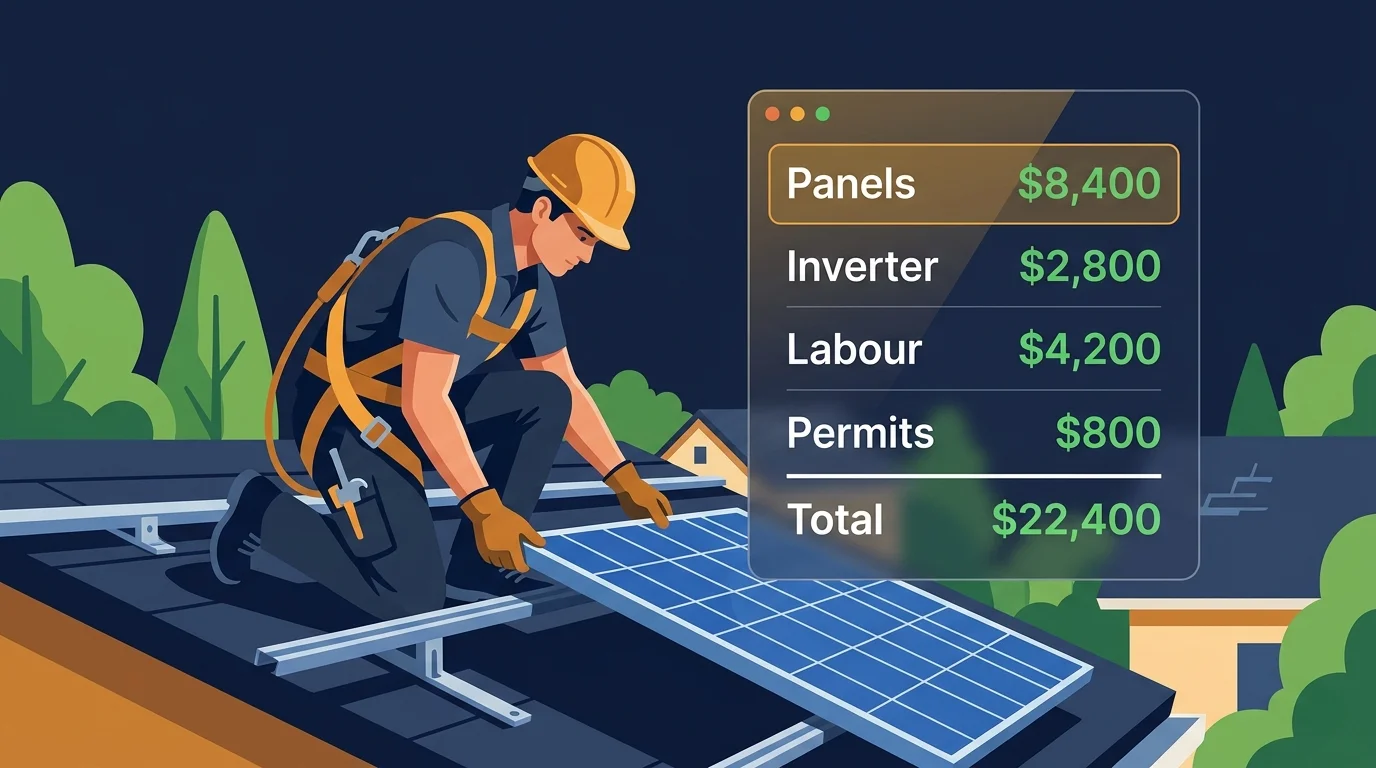
The first solar quote I ever saw landed in my inbox on a Tuesday afternoon. The total was $31,400. I nearly closed the tab immediately. It was only when I actually understood what that number included — and what happened to it after the 30% federal tax credit — that the investment started to make sense.
The problem with most solar cost articles is that they lead with a scary gross number and then bury the critical context. So let us do this differently. The average solar installation in the US in 2026 costs $16,000 to $35,000 before incentives. After the 30% federal tax credit, most homeowners pay $11,200 to $24,500 out of pocket. On a correctly sized system, that net investment pays back in 7 to 9 years and generates $40,000 to $80,000 in lifetime savings. Those are the numbers that matter for your decision.
This guide gives you the complete solar installation cost breakdown — by system size, by US state, by what each line item in your quote actually represents, and by what you can do to pay less without compromising on quality.
The Key Numbers:
| In 2026, the average US residential solar installation costs $2.80 to $3.50 per watt before incentives. For a typical 8kW system, that is $22,400 to $28,000 gross. After the 30% federal Investment Tax Credit, your net out-of-pocket cost drops to $15,680 to $19,600. In sun-rich states with additional state rebates, net costs can fall below $13,000. |
📊 NREL: National Renewable Energy Laboratory — U.S. Solar PV System Cost Benchmark Q1 2026
📌 Also Read:
How Much Does Solar Installation Cost in 2026? The National Overview
Solar installation costs in the United States have fallen dramatically over the past decade — down approximately 45% since 2015 — but they remain a significant household investment that requires careful evaluation. In 2026, the installed cost of a residential solar system ranges from $2.80 to $3.50 per watt, depending on system size, location, installer, and equipment quality.
Here is what that means in real-dollar terms at different system sizes:
| $2.80–$3.50/W | $15,680 | 30% | 7–9 years |
| 2026 US avg. installed cost | Net cost: 8kW after 30% ITC | Federal tax credit through 2032 | Avg. US payback period |
| System Size | Gross Cost (avg) | After 30% ITC | Monthly Savings | Payback Period | Best For |
| 4 kW | $11,200–$14,000 | $7,840–$9,800 | $80–$120/mo | 14–16 yrs | Small home, apartment |
| 5 kW | $14,000–$17,500 | $9,800–$12,250 | $100–$150/mo | 11–13 yrs | 2-bed, low usage |
| 6 kW | $16,800–$21,000 | $11,760–$14,700 | $120–$180/mo | 9–11 yrs | Average 3-bed home |
| 7 kW | $19,600–$24,500 | $13,720–$17,150 | $140–$200/mo | 8–10 yrs | Larger 3-bed home |
| 8 kW | $22,400–$28,000 | $15,680–$19,600 | $160–$220/mo | 7–9 yrs | 4-bed, avg US home |
| 10 kW | $28,000–$35,000 | $19,600–$24,500 | $200–$280/mo | 7–9 yrs | Large home, mild EV |
| 12 kW | $33,600–$42,000 | $23,520–$29,400 | $240–$330/mo | 7–8 yrs | Large home + EV |
Savings figures assume US average electricity rate of 16¢/kWh and 4.5 peak sun hours per day. Actual costs and savings vary significantly by state, installer, and roof conditions.
Use our solar panel cost calculator to get a personalised estimate for your exact home, location, and system size.
What Does Solar Installation Cost Include? The Full Breakdown
When an installer quotes you a total price, that number covers six distinct cost components. Understanding what each one represents helps you evaluate quotes intelligently and spot when something is overpriced or suspiciously cheap.
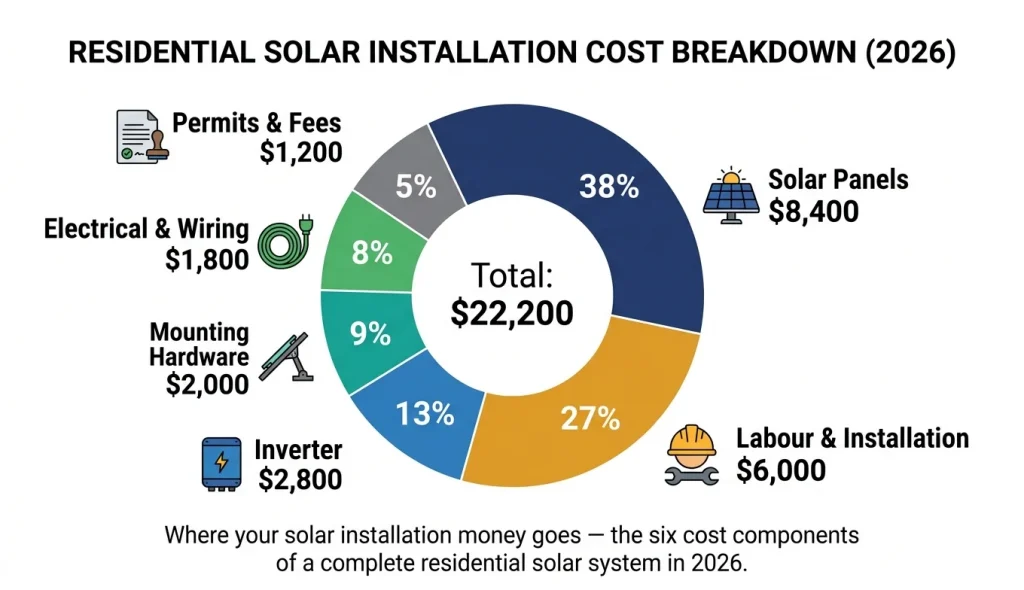
1. Solar Panels — 35–45% of Total Cost
The solar panels themselves are the largest single line item, typically representing 35 to 45% of the total installation cost. In 2026, residential monocrystalline panels are the standard — they offer the best efficiency-to-cost ratio at 20 to 22% efficiency. Premium panels from tier-1 manufacturers (SunPower, Panasonic, REC) cost more per panel but produce more electricity per square metre and carry better long-term warranties.
- Standard monocrystalline 400W panel (Tier 2): $180–$240 per panel
- Premium monocrystalline 400W panel (Tier 1): $250–$350 per panel
- High-efficiency 440W panel (SunPower, REC): $320–$450 per panel
For an 8kW system (20 panels at 400W), panel costs alone range from $3,600 to $7,000 depending on brand tier — a significant driver of total quote variation between installers.
2. Inverter — 10–15% of Total Cost
The inverter converts the direct current (DC) electricity your panels generate into the alternating current (AC) your home uses. There are three main types, each at a different price point:
| Inverter Type | Cost Range | Best For | Monitoring |
| String inverter | $1,000–$2,000 | Unshaded south-facing roofs | System-level only |
| Power optimisers | $2,500–$4,500 | Partial shading issues | Panel-level monitoring |
| Microinverters | $3,000–$6,000 | Complex roofs, mixed orientation | Full panel-level monitoring |
String inverters are the most affordable and perfectly suited to simple, unshaded roof configurations. Microinverters cost more but allow each panel to operate independently — meaning shade on one panel does not reduce the output of the entire system.
3. Labour and Installation — 25–30% of Total Cost
Labour is the second-largest cost component and the one that varies most significantly by region. In high labour-cost markets (California, New York, Massachusetts), installation labour can run $5,000 to $8,000 for an 8kW system. In lower labour-cost markets (Texas, Arizona, Southeast US), the same installation may cost $3,000 to $5,000. Labour includes roof penetration, panel mounting, electrical wiring to your main panel, and system commissioning.
4. Mounting Hardware and Racking — 8–12% of Total Cost
Racking systems secure your panels to the roof. Standard rail-based racking for a pitched roof typically costs $1,500 to $3,000 for an 8kW system. Rail-less racking is slightly more expensive but faster to install. Ground-mounted systems require additional concrete footings and can add $2,000 to $5,000 over a standard roof mount.
5. Electrical Components and Wiring — 6–10% of Total Cost
This includes the conduit, wiring, junction boxes, disconnect switches, and monitoring equipment. If your main electrical panel is old or undersized, a panel upgrade may be required — adding $1,500 to $4,000 to the project. Most modern homes (built after 2000 with a 200-amp panel) do not require an upgrade.
6. Permits, Inspections, and Grid Connection — 3–6% of Total Cost
Most jurisdictions require building permits and electrical inspections for solar installations. Permit costs vary from $200 in rural areas to $2,000 in major urban markets. Your utility also needs to approve your system for grid connection and net metering — a process that can take 2 to 8 weeks after installation. A reputable installer handles all permitting as part of the quoted price.
Solar Installation Cost by US State — 2026 Data
State-by-state, solar installation costs vary by 20 to 35% for identical system sizes. The main drivers are local labour rates, permit fee structures, utility interconnection fees, and the level of market competition among installers. High-solar states with many installers (California, Texas, Florida) tend to have more competitive pricing than lower-penetration markets.
| State | Cost per Watt | 8kW Gross Cost | After 30% ITC | State Incentives | Net After All |
| Arizona | $2.70/W | $21,600 | $15,120 | Prop Tax Exempt | $15,120 |
| California | $3.20/W | $25,600 | $17,920 | CSI rebates vary | $16,000–$18,000 |
| Florida | $2.90/W | $23,200 | $16,240 | Sales Tax Exempt | $16,240 |
| Texas | $2.80/W | $22,400 | $15,680 | Some local rebates | $14,000–$15,680 |
| Nevada | $2.70/W | $21,600 | $15,120 | NV rebates | $13,000–$15,120 |
| Massachusetts | $3.30/W | $26,400 | $18,480 | SMART programme | $14,000–$17,000 |
| New Jersey | $3.10/W | $24,800 | $17,360 | SREC income | $15,000–$17,360 |
| New York | $3.40/W | $27,200 | $19,040 | NY-Sun rebate ~$1/W | $10,000–$15,000 |
| Colorado | $2.90/W | $23,200 | $16,240 | Xcel rebates | $14,000–$16,240 |
| Hawaii | $3.50/W | $28,000 | $19,600 | No state ITC | $19,600 |
| Georgia | $2.80/W | $22,400 | $15,680 | Limited extras | $15,680 |
| Illinois | $3.00/W | $24,000 | $16,800 | Illinois Shines SREC | $14,000–$16,800 |
New York shows one of the highest gross costs but also one of the highest incentive stacks — the NY-Sun rebate alone can reduce your cost by $7,000 to $9,000 on top of the federal ITC, producing a net cost competitive with lower-cost states. Always research your full incentive stack before evaluating quotes.
📊 EnergySage: EnergySage Solar Panel Cost Data by State 2026
The 30% Federal Tax Credit — How It Actually Works
The 30% federal Investment Tax Credit (ITC) is the single most powerful financial tool available to US homeowners going solar in 2026. It is also one of the most misunderstood. Here is exactly how it works — without the jargon.
What the ITC Actually Is
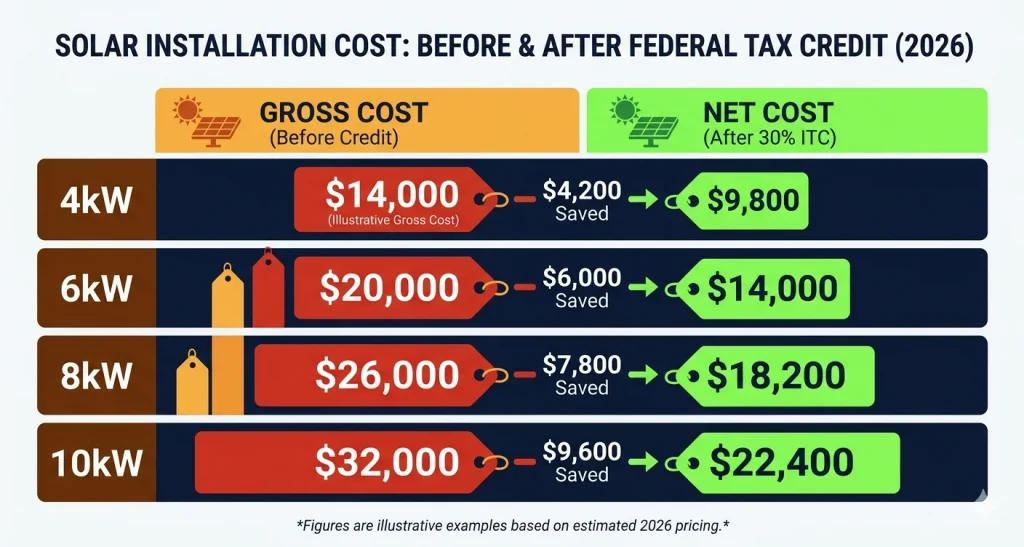
The Residential Clean Energy Credit (commonly called the solar ITC) allows you to deduct 30% of your total solar installation cost directly from your federal income tax bill. This is not a tax deduction — it is a dollar-for-dollar tax credit. On a $22,400 system, you receive a $6,720 reduction in the taxes you owe for the year of installation.
Does It Apply to Your Full Installation Cost?
Yes — the ITC applies to the complete installed system cost, including panels, inverter, mounting hardware, electrical work, labour, and battery storage if added at the same time. The only component it does not cover is the cost of a new roof undertaken purely for structural reasons unrelated to solar.
What Happens If Your Tax Credit Exceeds Your Tax Liability?
If your federal tax credit exceeds what you owe in taxes for the year of installation, the unused portion rolls forward to the following tax year. You do not lose it. For example, if your ITC credit is $7,200 but you only owe $5,000 in taxes, the remaining $2,200 rolls forward and reduces your tax bill the following year.
How to Claim It
The solar ITC is claimed by filing IRS Form 5695 (Residential Energy Credits) with your annual federal income tax return for the year your solar system is installed and operational. Your installer should provide you with documentation of the total installation cost. Most tax preparation software includes a guided walkthrough for claiming the credit.
📊 IRS: IRS Form 5695 — Residential Energy Credits: How to Claim Your Solar Tax Credit
| System Size | Gross Cost | 30% ITC Credit | Net Cost |
| 4 kW | $12,000 | −$3,600 | $8,400 |
| 6 kW | $18,000 | −$5,400 | $12,600 |
| 8 kW | $24,000 | −$7,200 | $16,800 |
| 10 kW | $30,000 | −$9,000 | $21,000 |
| 12 kW | $36,000 | −$10,800 | $25,200 |
Solar Installation Cost by Country — International 2026 Comparison
Solar installation costs vary enormously outside the US. Australia has some of the world’s lowest installation costs due to high market competition and volume. European markets are generally mid-range, though Germany and the UK have higher costs relative to their panel output due to labour rates and lower sun hours.
| Country | 8kW Gross Cost | Gov. Incentive | Net Cost | Payback Period | Currency |
| United States | $22,400–$28,000 | 30% ITC | $15,680–$19,600 | 7–9 yrs | USD |
| Australia | AUD $8,000–$11,000 | STC rebate ~30% | AUD $5,600–$7,700 | 4–6 yrs | AUD |
| Germany | €14,000–$18,000 | 20% VAT exempt | €11,200–$14,400 | 7–10 yrs | EUR |
| United Kingdom | £12,000–$16,000 | Zero VAT | £12,000–$16,000 | 11–13 yrs | GBP |
| Spain | €10,000–$14,000 | Regional rebates | €8,000–$11,200 | 5–7 yrs | EUR |
| Canada | CA$20,000–$28,000 | Canada Greener ~30% | CA$14,000–$19,600 | 11–13 yrs | CAD |
| Netherlands | €12,000–$16,000 | 21% VAT exempt | €9,480–$12,640 | 8–10 yrs | EUR |
| India | ₹400,000–$600,000 | 30–40% subsidy | ₹240,000–$420,000 | 6–9 yrs | INR |
Australia’s low gross installation costs reflect a mature, competitive market with over 3 million residential installations generating volume pricing. Combined with generous STC rebates that effectively reduce the cost by 25 to 35%, Australian homeowners pay some of the lowest net prices for solar in the developed world.
📊 DOE: U.S. Department of Energy — Residential Solar Costs and Incentives 2026
What Affects Solar Installation Costs? 6 Key Variables
Two homeowners with the same size system can receive quotes that differ by $8,000 or more. Here is what drives that variation and which factors you can control.
1. System Size — The Primary Driver
Larger systems cost more in total but less per watt — the cost per watt typically decreases as system size increases. A 4kW system might cost $3.40/W while a 12kW system with the same installer might cost $2.90/W. This economy of scale means that sizing correctly and not under-sizing is financially important — a properly sized 10kW system often costs only 20% more than a 6kW system but generates nearly 70% more electricity.
2. Panel Brand and Quality Tier
The difference between a budget-tier and premium-tier panel can be $80 to $150 per panel — adding $1,600 to $3,000 to an 8kW system. Premium panels offer higher efficiency (generating more power per m² of roof space), better degradation warranties (guaranteeing higher output at year 25), and longer product warranties. For homeowners with limited roof space, the higher cost per panel can be justified by the additional output.
3. Inverter Type Chosen
As noted in the cost breakdown section, choosing microinverters over a string inverter can add $1,500 to $4,000 to your quote. This premium is justified if your roof has significant shading or multiple orientations. On a simple, unshaded south-facing roof, a quality string inverter delivers equivalent performance at lower cost.
4. Roof Complexity and Condition
Standard labour quotes assume a straightforward pitched roof with easy access. Complex roof configurations — multiple planes, steep pitch, tile roofing (which requires additional care), or limited access — add $500 to $2,500 to installation costs. If your roof is older or requires any repair work before installation, this is handled separately before solar work begins.
5. Electrical Panel Upgrade Requirements
Homes with older 100-amp panels or panels without sufficient circuit capacity for a solar system require an upgrade to 200-amp service before installation. This adds $1,500 to $4,000 to your project and may extend the installation timeline by 1 to 3 weeks while the utility schedules the meter work. Ask your installer to assess panel capacity as part of the quote process.
6. Installer Margin and Market Competition
Installer pricing varies by 30 to 50% for identical systems in the same market. This is the most controllable variable — and the one most homeowners underestimate. Getting three quotes from certified installers is not just a prudent precaution; in many markets it is the single most impactful cost-saving action available to you. The difference between the most and least expensive quote for the same system can fund an additional 3 to 5 panels or a quality battery upgrade.
How to Get the Best Price on Your Solar Installation — 5 Practical Steps
Understanding costs is only half the picture. Here is the practical action plan for getting the best possible price on your installation.
Step 1 — Get at Least 3 Quotes
This is the single most impactful action. Use EnergySage (US), Solar Choice (Australia), or Which? Trusted Traders (UK) to compare certified installers. These platforms show you multiple quotes on a standardised comparison basis — making it easy to see when one installer is charging significantly more for the same equipment.
Step 2 — Research Your Full Incentive Stack Before Negotiating
Knowing your exact incentive value before entering quote discussions puts you in a stronger negotiating position. If you know your net cost after the federal ITC and state rebate is $13,500, you can evaluate whether an installer’s price represents genuine value. Use our solar tax credit calculator to calculate your full incentive stack before requesting quotes.
Step 3 — Compare Total Cost, Not Just Price Per Panel
Some installers quote aggressively on panels but charge premium rates for labour, monitoring subscriptions, or extended warranties. Always request a fully itemised quote showing: panel cost, inverter cost, labour, mounting hardware, electrical work, permits, and any ongoing service fees. Compare the total project cost, not individual line items in isolation.
Step 4 — Ask About End-of-Season or Off-Peak Timing
Solar installers have seasonal demand cycles. Spring and early summer are peak installation periods in most US markets — installers are busiest and have less incentive to negotiate. Late autumn and winter installations sometimes carry 5 to 10% discounts as installers fill schedule gaps. If your timeline allows, asking specifically about off-peak availability can save $800 to $2,500 on a typical installation.
Step 5 — Check Installer Certification and Warranty Terms
The cheapest quote is not always the best value. NABCEP-certified installers (US) have demonstrated competency through rigorous testing and ongoing education requirements. Always verify that your installer’s workmanship warranty is at least 10 years — not just the manufacturer’s panel and inverter warranties. A 25-year panel warranty is worthless if the installer goes out of business and there is no workmanship coverage on the installation itself.
Frequently Asked Questions
How much does a solar panel system cost for an average house in 2026?
For the average US home consuming approximately 900 kWh per month, a correctly sized 8kW solar system costs $22,400 to $28,000 before incentives in 2026. After the 30% federal Investment Tax Credit, the net out-of-pocket cost is $15,680 to $19,600. In states with additional incentives — New York, Massachusetts, New Jersey, Illinois — the effective net cost can fall below $12,000 to $15,000.
Is it cheaper to install solar panels yourself?
DIY solar installation is technically possible and can reduce costs by 25 to 40% — but it comes with significant trade-offs. You must handle permitting, utility interconnection approval, and electrical code compliance yourself. Most DIY installations are not eligible for net metering unless certified by a licensed electrician. You also lose access to the installer’s workmanship warranty and may void equipment warranties if installation does not meet manufacturer specifications. For most homeowners, the risk-adjusted cost of a professional installation is the better choice.
Does solar panel installation cost include the permit?
Yes — reputable installers include permit fees in their quoted price as a standard part of the project. Be wary of any quote that lists permits as a separate line item to be billed later or marked as ‘TBD’. Permit costs are predictable and should be included in any professional quote. If an installer asks you to pull your own permits, this is a red flag in most markets.
How long does solar installation take from quote to switch-on?
The typical timeline from signed contract to system activation is 4 to 12 weeks in most US markets. Physical installation of the panels and equipment usually takes 1 to 2 days. The majority of the timeline is administrative — permit approval (1 to 3 weeks), utility interconnection application and approval (2 to 6 weeks), and final inspection scheduling (1 to 2 weeks). Markets with high solar adoption and streamlined permitting processes — Arizona, California, Florida — tend to have faster timelines than newer markets with manual approval processes.
1 thought on “How Much Does Solar Installation Cost in 2026? The Complete Price Breakdown”