
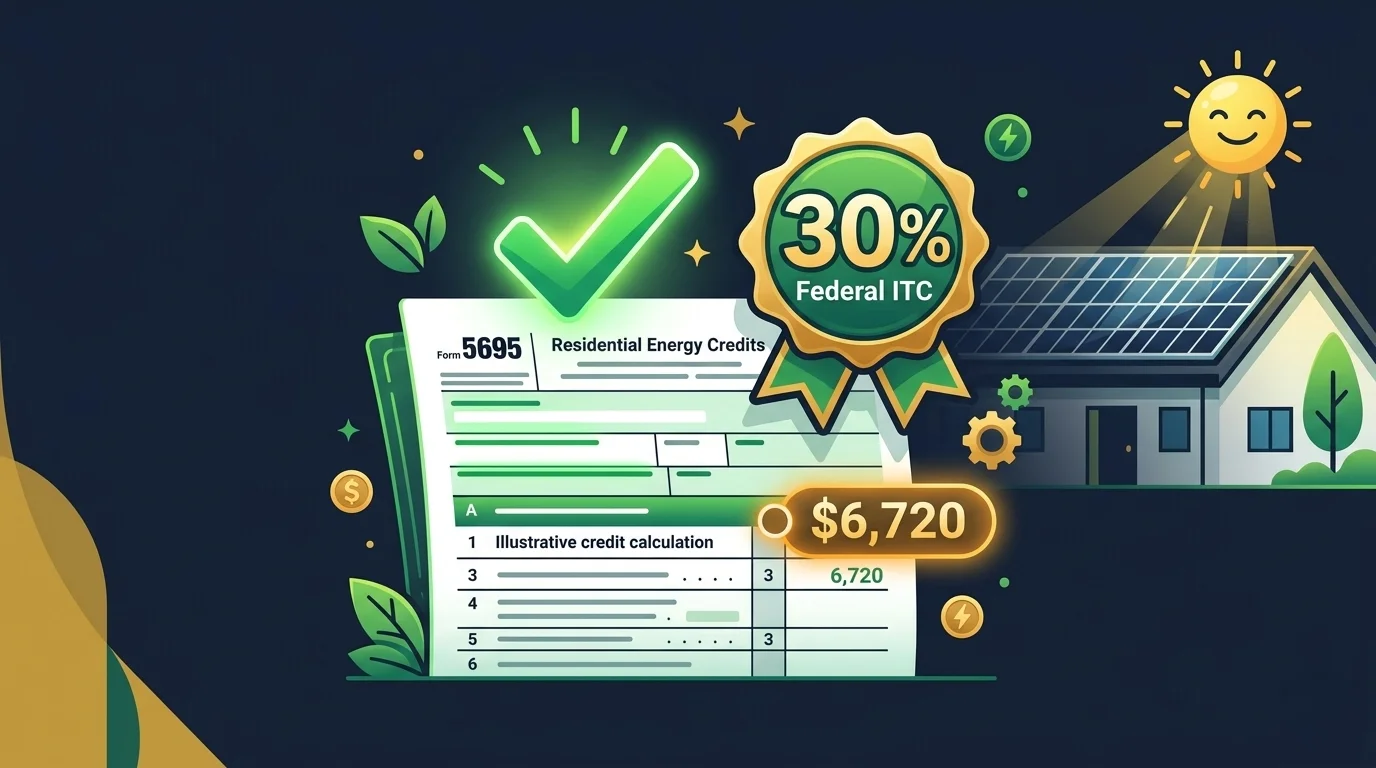
I have spoken to dozens of homeowners who went solar and claimed the 30% federal tax credit — and nearly all of them said the same thing when the credit actually hit their tax return: ‘I knew it existed, but I had no idea it would be this much.’
On a $24,000 solar system, the credit is $7,200. That is a dollar-for-dollar reduction in what you owe the IRS — not a deduction, not a refund estimate, but a direct reduction in your tax bill. For most middle-income households, $7,200 is more than three months of mortgage payments. Claiming it correctly is one of the most valuable single actions a solar homeowner can take.
The challenge is that the solar tax credit — officially called the Residential Clean Energy Credit — is widely referenced but poorly explained. This guide gives you the complete picture: what it is, exactly who qualifies, what installation costs it covers, how to calculate your specific credit amount, and the precise step-by-step process to claim it on IRS Form 5695.
The Most Important Thing to Understand:
| The 30% solar tax credit is a dollar-for-dollar reduction in your federal income tax liability — not a tax deduction. A $7,200 credit does not reduce your taxable income by $7,200. It reduces your actual tax bill by $7,200. If you owe $10,000 in federal income tax for the year, a $7,200 solar credit reduces your payment to $2,800. This distinction makes it one of the most valuable residential tax benefits available to homeowners in 2026. |
📊 IRS: IRS Form 5695 — Residential Energy Credits: Official Instructions 2026
📌 Also Read:
What Is the 30% Solar Tax Credit in 2026?
The Residential Clean Energy Credit — commonly called the solar Investment Tax Credit or solar ITC — is a federal income tax credit that allows US homeowners to deduct 30% of the total cost of their solar panel installation directly from their federal income tax liability. It was established under the Inflation Reduction Act of 2022 and is currently available at the 30% rate through the end of 2032.
To be precise about the mechanics: if your total solar installation cost is $22,400 and your 30% credit is $6,720, that $6,720 is subtracted dollar-for-dollar from whatever you owe the IRS for that tax year. It is not a refund — it cannot reduce your tax liability below zero and produce a cash payment. But any unused credit rolls forward to future tax years until it is fully used.
| 30% | $5K–$10K | $0 cash limit | 2032 |
| Credit rate through 2032 | Typical credit for US homeowners | Cannot go below zero — rolls forward | Last year at 30% rate |
The credit applies to residential solar photovoltaic (PV) systems, solar water heating systems, wind turbines, fuel cells, geothermal heat pumps, and battery storage systems installed in 2026. This guide focuses on solar PV — the most common application — but the mechanics are identical for other qualifying technologies.
Who Qualifies for the 30% Solar Tax Credit in 2026?
The qualification requirements are straightforward but must all be met to claim the credit. Here is the complete eligibility checklist:
| Requirement | Detail |
| You own the solar system | System must be purchased outright or financed with a loan. Leased systems and PPAs do not qualify — the company that owns the system claims the credit, not you. |
| The system is on your US residence | Must be installed at your primary home or a second home you use personally. Does not apply to purely investment rental properties. |
| The system was newly installed | Applies to new installations. Existing systems already in service do not generate a new credit. |
| The system is operational | The system must be installed and producing electricity before the end of the tax year in which you claim it. |
| You have federal tax liability | The credit reduces federal income taxes owed. If your federal tax liability is $0, you cannot use the credit in that year — but it rolls forward to future years. |
| The system meets IRS standards | System must meet applicable fire and electrical safety codes. Reputable NABCEP-certified installers ensure compliance automatically. |
Note that there are no income limits for the residential solar tax credit. Unlike some other tax incentives, the ITC is available to any US homeowner who meets the above requirements regardless of income level. High-income and low-income homeowners alike are eligible.
📊 DOE: U.S. Department of Energy — Homeowner’s Guide to the Federal Tax Credit for Solar Photovoltaics
What Does the Solar Tax Credit Cover? The Complete List
One of the most common areas of confusion is exactly which costs the 30% credit applies to. The ITC covers the full installed system cost — not just the panels. Here is the complete breakdown of what qualifies:
| Cost Component | Qualifies for 30% ITC? | Notes |
| Solar panels (PV modules) | ✅ Yes — 100% | All panel types qualify |
| Inverter | ✅ Yes — 100% | String, micro, or power optimiser |
| Mounting and racking hardware | ✅ Yes — 100% | Roof and ground mount systems |
| Electrical wiring and conduit | ✅ Yes — 100% | All system wiring qualifies |
| Labour and installation costs | ✅ Yes — 100% | Including all contractor labour |
| Permit and inspection fees | ✅ Yes — 100% | Fees paid as part of the project |
| Battery storage (installed with solar) | ✅ Yes — 100% | Must be installed at same time as solar |
| Battery storage (added later) | ✅ Yes — 100% | Also qualifies if added later — different installation |
| Roof repairs required FOR solar mount | ✅ Partial | Only portion directly related to solar mount |
| New roof replacement | ❌ No | Roof replacement not a solar cost |
| Extended warranties / service plans | ❌ No | Maintenance contracts do not qualify |
| Solar lease payments | ❌ No | You don’t own the system — company claims credit |
The key rule: if the cost is directly necessary to install and operate your solar PV system, it qualifies. If it is a separate maintenance, warranty, or structural improvement not directly required by the solar installation, it does not.
The 30% ITC Schedule — When the Rate Changes
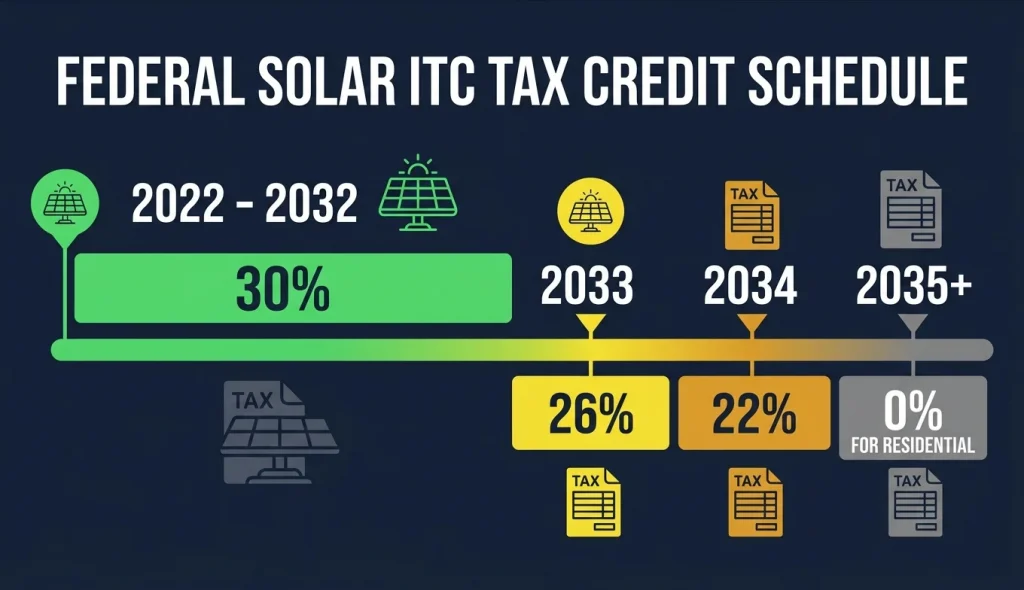
The Inflation Reduction Act locked in the 30% rate through 2032, providing long-term certainty for homeowners and installers. However, the credit begins to step down after 2032 and expires for residential installations in 2035. Here is the full schedule:
| Tax Year | Credit Rate | Commercial Rate | Action Required |
| 2022–2032 | 30% residential | 30% commercial | ✅ Act anytime — full credit |
| 2033 | 26% residential | 26% commercial | ⚠️ Rate begins to step down |
| 2034 | 22% residential | 22% commercial | ⚠️ Significantly reduced |
| 2035+ | 0% residential | 10% commercial | ❌ Residential credit expires |
The practical implication: any homeowner installing solar between now and December 31, 2032 qualifies for the full 30% credit. There is no rush created by an imminent deadline — but the knowledge that the rate begins declining in 2033 and expires for residential use in 2035 provides a clear long-term window for planning.
How to Calculate Your Solar Tax Credit — Step by Step
The calculation is straightforward once you have your installer’s final invoice in hand. Here is the exact process:
Step 1 — Determine Your Qualifying Cost
Add up all eligible costs from your solar installation invoice. This typically includes panels, inverter, mounting hardware, electrical work, labour, and permit fees. If you added battery storage, include that cost as well. Do not include any costs for roof replacement, extended service plans, or other non-solar work done at the same time.
Example: $22,400 total installation cost (all components qualify)
Step 2 — Multiply by 30%
Multiply your total qualifying cost by 0.30 (30%) to get your credit amount.
Example: $22,400 × 0.30 = $6,720 credit
Step 3 — Compare to Your Federal Tax Liability
Check your most recent federal tax return for your total federal income tax liability (Line 24 of Form 1040 — ‘Tax’). This is your total tax before withholding credits, not your refund or amount owed after withholding. Compare this to your solar credit.
- If your tax liability equals or exceeds your credit ($6,720 or more in our example), you use the full credit in the year of installation
- If your tax liability is less than your credit, you use as much as you can this year and roll the remainder forward to the next tax year
Step 4 — Enter on IRS Form 5695
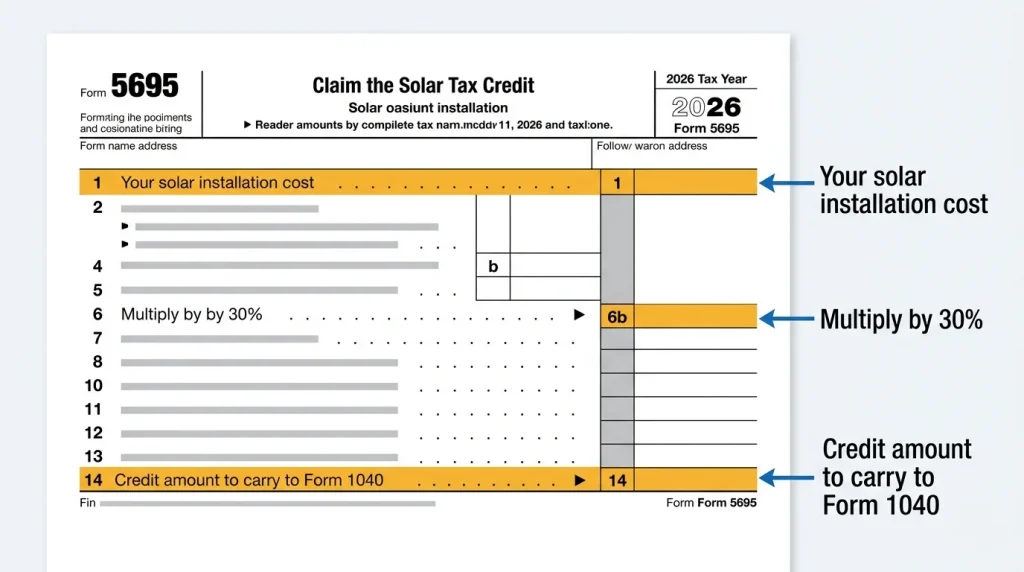
Your solar credit is claimed on IRS Form 5695 (Residential Energy Credits) and flows to Schedule 3, then to Line 20 of Form 1040. The key lines on Form 5695:
- Line 1: Enter your total qualifying solar costs
- Line 6b: Multiply Line 1 by 30% — this is your Residential Clean Energy Credit
- Lines 12–14: Calculate how much of the credit applies in the current year vs carries forward
Most tax preparation software (TurboTax, H&R Block, TaxAct, FreeTaxUSA) has a guided solar tax credit section that walks you through Form 5695 automatically. You enter your installation cost and the software calculates and applies the credit.
| Installation Cost | 30% Credit | Fed. Tax Liability Needed | Result |
| $14,000 | $4,200 | $4,200+ | Full credit in Year 1 |
| $18,000 | $5,400 | $5,400+ | Full credit in Year 1 |
| $22,400 | $6,720 | $6,720+ | Full credit in Year 1 |
| $28,000 | $8,400 | $8,400+ | Full credit in Year 1 |
| $35,000 | $10,500 | $10,500+ | Full credit in Year 1 |
| $22,400 | $6,720 | $4,000 only | $4,000 year 1, $2,720 rolls forward |
📌 Also Read:
How to Claim the Solar Tax Credit — The Complete Filing Guide
Claiming the solar ITC is simpler than most homeowners expect. Here is the step-by-step process from installation to tax return:
1. Collect Your Documentation
Before filing, gather: your final installer invoice showing total project cost broken down by component, your interconnection approval letter from your utility (confirming the system is operational), and any state rebate or incentive documentation (state rebates may reduce your qualifying cost in some cases — confirm with your tax advisor).
2. Confirm Your System is Operational
The IRS requires the system to be installed and producing electricity before the end of the tax year in which you claim the credit. If your system was commissioned on December 28, 2026, you can claim it on your 2026 return. If commissioning slips to January 2, 2027, it applies to your 2027 return.
3. Complete IRS Form 5695
Download IRS Form 5695 from irs.gov, or use tax software that handles it automatically. Part I of Form 5695 covers Residential Clean Energy Credits (your solar installation). You will enter your total qualifying installation cost and calculate the 30% credit. The form also handles situations where the credit exceeds your tax liability by calculating the carryforward to future years.
4. Transfer to Form 1040 via Schedule 3
Your Form 5695 credit amount flows to Schedule 3 (Additional Credits and Payments), Line 5. Schedule 3 then feeds into your Form 1040, Line 20. This reduces your total tax liability by the credit amount. Your tax software does this automatically — you simply enter the Form 5695 information and the credit flows through to your 1040 without any additional manual work.
5. Handle the Carryforward if Needed
If your credit exceeds your tax liability in year one, Form 5695 automatically calculates the unused amount that carries forward. In subsequent years, you include a new Form 5695 showing the carryforward amount from the prior year. This continues until the full credit is used. There is no time limit on the carryforward within the credit’s eligibility window.
State Solar Tax Credits and Rebates — What Else You Can Claim
The federal 30% ITC is the largest single incentive — but many states offer additional credits, rebates, and programmes that stack on top of the federal credit. Here is the key landscape for 2026:
| State | State Incentive | Value | Stacks With ITC? | Where to Claim |
| New York | NY-Sun rebate + state tax credit | $5,000–$9,000 combined | Yes ✅ | NY state tax return + installer |
| Massachusetts | SMART programme per-kWh income | $100–$400/yr for 10 yrs | Yes ✅ | Automatic via utility enrollment |
| New Jersey | SREC income (quarterly certificates) | $150–$400/yr | Yes ✅ | NJ SREC market via aggregator |
| Illinois | Illinois Shines SREC programme | $2,000–$6,000 | Yes ✅ | Through approved installer |
| Maryland | State tax credit 30% (capped $1,000) | Up to $1,000 | Yes ✅ | Maryland state tax return |
| South Carolina | State tax credit 25% (capped $3,500) | Up to $3,500 | Yes ✅ | SC state tax return |
| Hawaii | State tax credit 35% (capped $5,000) | Up to $5,000 | Yes ✅ | Hawaii state tax return |
| Montana | State tax credit 100% (capped $500) | Up to $500 | Yes ✅ | Montana state tax return |
Most property tax exemptions and sales tax exemptions for solar do not need to be ‘claimed’ — they are applied automatically by your county assessor (property tax) or at point of sale (sales tax exemption states like Arizona, Florida, and Texas). Check your state’s DSIRE listing for the full picture.
📊 DSIRE: DSIRE — Database of State Incentives for Renewables and Efficiency — Full State Listings
Common Mistakes When Claiming the Solar Tax Credit
These are the most frequent errors homeowners make — and how to avoid each one:
Mistake 1 — Confusing a Tax Credit with a Tax Deduction
A tax deduction reduces your taxable income. A tax credit reduces your tax bill directly. If you are in the 22% tax bracket, a $6,720 tax deduction would save you $6,720 × 22% = $1,478. The same amount as a tax credit saves you the full $6,720. The solar ITC is a credit — far more valuable than a deduction of the same size. Make sure your tax preparer understands this distinction.
Mistake 2 — Claiming on a Leased System
If you signed a solar lease or PPA, you do not own the system — the solar company does. The solar company claims the tax credit, not you. This is one of the principal financial disadvantages of leasing versus buying. If you are evaluating financing options, a solar loan preserves your eligibility for the full credit.
Mistake 3 — Forgetting the Carryforward
Homeowners who had lower-than-expected tax liability in their installation year sometimes assume they lost the unused portion of their credit. They did not — it carries forward automatically to future tax years. Keep your Form 5695 from the installation year and ensure your tax preparer applies the carryforward in subsequent years until the full credit is used.
Mistake 4 — Not Including Battery Storage
If you installed battery storage alongside your solar system — or even if you add it later in a separate installation — it qualifies for the full 30% credit separately. Many homeowners claim only their panel and inverter costs and overlook the battery. On a $12,000 Tesla Powerwall installation, the ITC credit is $3,600 — a significant oversight if missed.
Mistake 5 — Applying a State Rebate Before Calculating the Federal Credit
The order of operations matters. The federal ITC is calculated on your gross installation cost before any state rebates are applied. A state rebate received reduces your basis for future depreciation calculations (relevant for home offices or rental components) but does not reduce your federal ITC calculation. Consult a tax professional if your installation serves mixed residential and business purposes.
Frequently Asked Questions
Can I claim the solar tax credit if I get a tax refund?
The solar ITC reduces your federal tax liability — the amount of federal income tax you owe for the year. If you normally receive a refund because your withholding exceeds your tax liability, the credit can increase your refund by reducing your liability further. However, the credit cannot exceed your total federal tax liability — if it would reduce your tax below zero, the remainder carries forward to the next tax year rather than generating a cash refund.
What if I cannot use the full credit in one year?
Any unused credit carries forward to subsequent tax years indefinitely within the eligibility window (through 2032 at the 30% rate). You claim the credit on Form 5695 each year, showing the amount used in the current year and the amount carrying forward. There is no penalty for claiming the credit over multiple years — the full value is preserved.
Does adding a battery storage system qualify for the 30% credit?
Yes — battery storage systems installed alongside or separately from a solar system qualify for the full 30% Residential Clean Energy Credit in 2026. Since the Inflation Reduction Act of 2022, standalone battery storage (without solar) also qualifies, provided the battery has at least a 3 kWh capacity. This means a Tesla Powerwall, Enphase IQ Battery, or similar residential system installed independently can generate a tax credit of $3,000 to $5,000 on its own.
Does the solar tax credit affect my home’s cost basis for capital gains purposes?
Yes — the federal solar ITC reduces your home’s adjusted cost basis for capital gains calculation purposes, but only by the amount of the credit (not the full installation cost). When you sell your home, the reduced basis could slightly increase any capital gains subject to tax. However, for most homeowners who qualify for the primary residence capital gains exclusion ($250,000 single / $500,000 married), this has no practical impact. Homeowners with high-value properties or rental components should consult a tax professional.