
When a homeowner in New Jersey asks me to review their solar financials, the first thing I check after the electricity savings and the ITC credit is their SREC setup. In New Jersey, a well-performing 8kW solar system generates approximately 9 to 11 SRECs per year. At current NJ SREC prices of $200 to $350 per certificate, that is $1,800 to $3,850 per year in additional income — on top of everything else solar already provides.
Many homeowners in SREC states have never heard of SRECs. Some have heard of them but assumed their installer handled the enrollment automatically. A significant number — especially those who installed several years ago with a solar lease — are not eligible and do not know it. Understanding whether your state has an SREC market, what your certificates are worth, and how to sell them is one of the most impactful financial checks a solar homeowner can make.
This guide covers what SRECs are, which states have active SREC markets in 2026, what the certificates are worth by state, how to calculate your annual SREC income using an SREC value calculator, and exactly how to sell your SRECs for the best price.
The Key Concept:
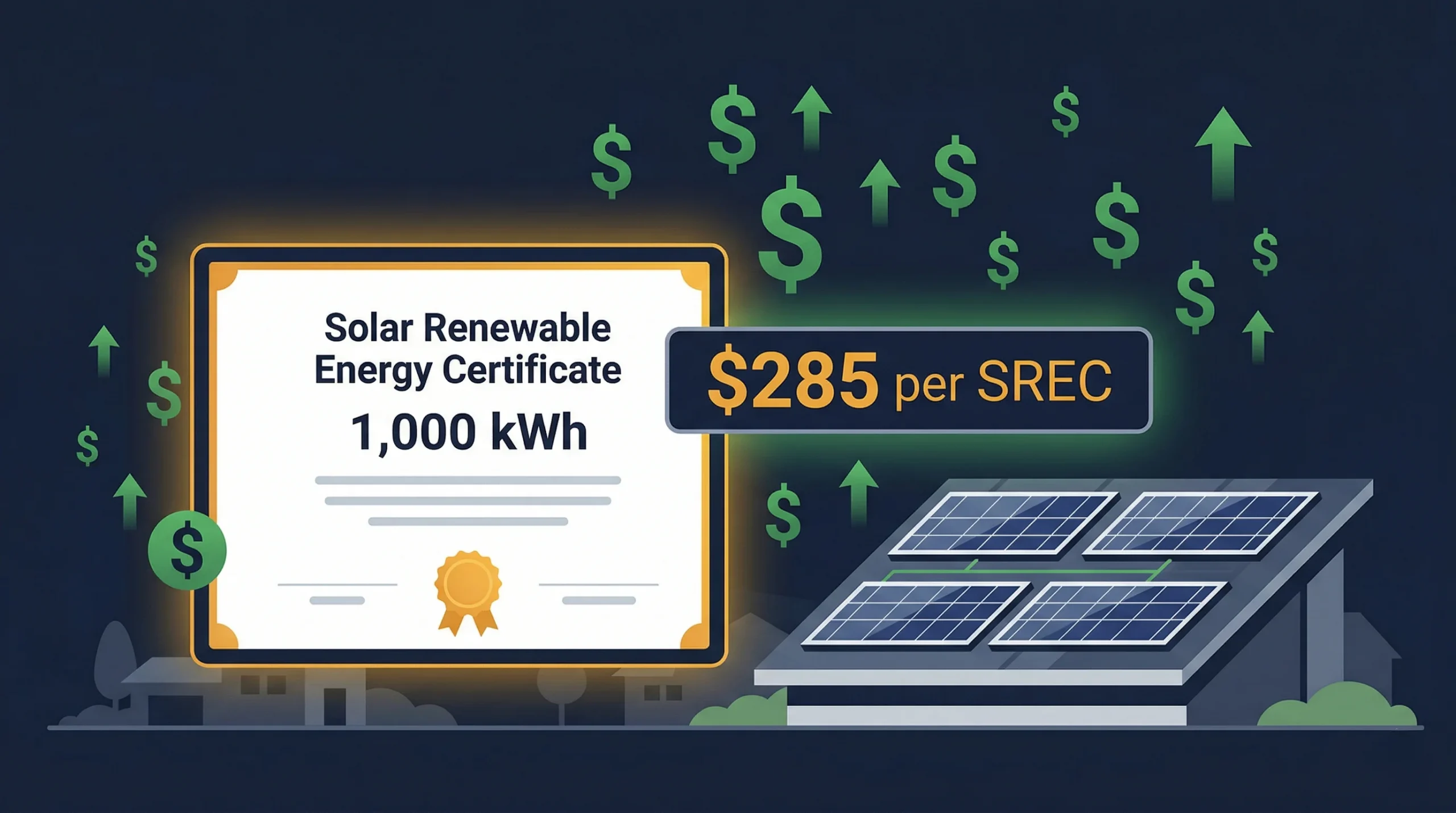
| A Solar Renewable Energy Certificate (SREC) is a tradeable certificate that represents the environmental attributes of 1,000 kWh (1 MWh) of solar electricity generation. Utilities in states with Renewable Portfolio Standards (RPS) that include a solar carve-out must purchase SRECs to prove compliance with state law. This creates a market in which solar homeowners can sell their certificates for income — separate from their electricity savings and independent of the federal tax credit. |
📊 SRECTrade: SRECTrade — Live SREC Market Prices by State 2026
📌 Also Read:
What Is an SREC and How Does the Market Work?
A Solar Renewable Energy Certificate (SREC) is a market instrument that represents the environmental value of 1,000 kWh of solar electricity generation. Your solar system generates one SREC for every 1,000 kilowatt-hours it produces. An 8kW system generating 10,000 kWh per year produces approximately 10 SRECs per year.
The SREC market exists because many US states have enacted Renewable Portfolio Standards (RPS) that require utilities to source a specific percentage of their electricity from solar energy. Utilities that do not own enough solar themselves must purchase SRECs from owners who do — including residential solar homeowners. This creates a trading market where SREC prices are set by the balance between solar generation supply and utility demand.
| 1 SREC | 10 SRECs/yr | $150–$350 | $1,500–$3,500 |
| = 1,000 kWh of solar generation | typical 8kW system in SREC state | NJ SREC current price range | typical annual NJ SREC income |
SREC Value by State — What Your Certificates Are Worth in 2026
SREC prices vary dramatically between states — and can also fluctuate significantly within a single state depending on market supply and demand. Here is the current landscape by state for 2026:
| State | SREC Price (2026) | SRECs/yr (8kW) | Annual Income | 10-Year Gross | Market Status |
| New Jersey | $150–$350 | 9–11 | $1,350–$3,850 | $13,500–$38,500 | ✅ Active — high value |
| Massachusetts | $200–$380 | 8–10 | $1,600–$3,800 | $16,000–$38,000 | ✅ Active — SMART programme |
| Maryland | $60–$100 | 8–9 | $480–$900 | $4,800–$9,000 | ✅ Active — moderate value |
| Pennsylvania | $5–$20 | 8–9 | $40–$180 | $400–$1,800 | ⚠️ Low value — oversupply |
| Ohio | $2–$8 | 7–8 | $14–$64 | $140–$640 | ⚠️ Very low — near zero |
| Delaware | $15–$45 | 8–9 | $120–$405 | $1,200–$4,050 | ✅ Moderate value |
| Washington DC | $350–$450 | 7–8 | $2,450–$3,600 | $24,500–$36,000 | ✅ Highest value in US |
| Illinois | Block payment | 8–9 | $2,000–$6,000 upfront | One-time block | ✅ Illinois Shines upfront |
| Virginia | $2–$8 | 7–8 | $14–$64 | $140–$640 | ⚠️ Emerging market |
| North Carolina | $3–$10 | 7–9 | $21–$90 | $210–$900 | ⚠️ Very low currently |
Washington DC has the highest SREC prices in the US in 2026 — driven by the DC government’s ambitious 100% renewable electricity mandate and a limited local supply of solar installations. New Jersey and Massachusetts follow closely with well-established, liquid markets. Pennsylvania, Ohio, and Virginia have seen SREC prices collapse to near-zero levels due to an oversupply of solar SRECs relative to utility demand.
📊 EnergySage: EnergySage — SREC Values by State: What Solar Certificates Are Worth in 2026
How to Calculate Your Annual SREC Income — The SREC Value Calculator Method
Calculating your SREC income requires three numbers: your annual solar generation, the number of SRECs that production generates, and the current market price per SREC in your state.
Step 1 — Calculate Your Annual Generation
Your annual solar generation in kWh comes from your installer’s estimate or your monitoring system. For a typical 8kW system:
- Arizona (6.5 sun hours/day): 8 × 6.5 × 365 × 0.80 = 15,184 kWh/year
- New Jersey (4.6 sun hours/day): 8 × 4.6 × 365 × 0.80 = 10,746 kWh/year
- Massachusetts (4.3 sun hours/day): 8 × 4.3 × 365 × 0.80 = 10,046 kWh/year
- Maryland (4.5 sun hours/day): 8 × 4.5 × 365 × 0.80 = 10,512 kWh/year
Step 2 — Convert to SRECs
Divide your annual generation by 1,000 to get your annual SREC production:
- 10,746 kWh ÷ 1,000 = 10.7 SRECs per year (New Jersey 8kW)
- 10,046 kWh ÷ 1,000 = 10.0 SRECs per year (Massachusetts 8kW)
- 10,512 kWh ÷ 1,000 = 10.5 SRECs per year (Maryland 8kW)
Step 3 — Multiply by Current SREC Price
Find the current SREC price for your state at SRECTrade.com or through your broker, then multiply:
| State | Annual SRECs (8kW) | SREC Price | Annual Income | 10-Year Projection |
| New Jersey | 10.7 | $250 (mid-range) | $2,675/yr | $26,750 |
| Massachusetts | 10.0 | $290 (mid-range) | $2,900/yr | $29,000 |
| Washington DC | 7.8 | $400 (mid-range) | $3,120/yr | $31,200 |
| Maryland | 10.5 | $80 (current) | $840/yr | $8,400 |
| Delaware | 9.2 | $30 (current) | $276/yr | $2,760 |
| Pennsylvania | 9.0 | $10 (current) | $90/yr | $900 |
📌 Also Read:
How to Sell Your SRECs — Step by Step
Generating SRECs is automatic — your system produces them as it generates electricity, registered through your state’s tracking system. Selling them requires a few setup steps that your installer may or may not have handled for you.
Step 1 — Register Your System with Your State’s SREC Tracking System
Each state uses a different electronic tracking system to record SREC generation:
- New Jersey, Maryland, Delaware, Pennsylvania, DC: PJM-EIS GATS (Generation Attribute Tracking System) — register at pjm-eis.com
- Massachusetts: NEPOOL GIS (New England Power Pool Generation Information System) — register at nepoolgis.com
- Ohio, Virginia: M-RETS (Midwest Renewable Energy Tracking System)
- Illinois: Illinois Shines programme — your installer handles registration
Most reputable solar installers in SREC states handle the system registration as part of the installation process. If you installed solar and have never received SREC income, check whether your system is registered — you may be generating SRECs that have been accumulating unclaimed.
Step 2 — Choose Your Sales Method
There are three ways to sell your SRECs, each with different price and effort trade-offs:
| Method | Price You Get | Effort | Best For | Platforms |
| Spot market sale | Current spot price | Low — sell as generated | Quick income, flexible | SRECTrade, Sol Systems |
| Long-term contract (1–3 yr) | Fixed price below spot | Very low — automatic | Predictable income | SRECTrade, Flett Exchange |
| Long-term contract (5–10 yr) | Locked price, often below spot | Very low — set and forget | Security over max income | Utility direct contracts |
| Broker aggregation | Spot minus 5–15% fee | Low | Small system owners | SRECTrade, Sol Systems, SREC International |
| Direct utility sale | Varies — sometimes above market | Moderate — negotiate | Large systems, commercial | Utility RFP programmes |
For most residential homeowners, using an SREC aggregator like SRECTrade or Sol Systems is the simplest and most efficient approach. You register your system, connect your monitoring data, and receive quarterly or monthly payments automatically. The broker fee (typically 5 to 15%) is a reasonable cost for the simplicity and market access they provide.
Step 3 — Monitor Market Prices and Adjust Strategy
SREC markets are dynamic. New Jersey SREC prices have ranged from $150 to $690 over the past decade — with current 2026 prices at $200 to $350. Pennsylvania prices have collapsed from $300 to under $15 as the market became oversupplied. Monitoring current prices at SRECTrade.com quarterly helps you decide whether to sell immediately or hold certificates in hopes of price recovery.
One important note: SRECs have expiration dates. In most states, SRECs expire 3 to 5 years after generation. Do not hold certificates indefinitely hoping for price recovery — check your state’s expiration rules and sell well before the expiry date to avoid losing the value entirely.
SREC Tax Treatment — What You Need to Know
SREC income is taxable in the US. Here is how it is treated:
For Most Homeowners — Ordinary Income
SREC income received by homeowners is generally treated as ordinary income and reported on Schedule 1 of Form 1040 (Other Income). Your SREC broker or aggregator will typically issue you a 1099-MISC or 1099-NEC for the year if your total SREC income exceeds $600. You owe income tax on SREC proceeds at your marginal tax rate — there is no special preferential treatment.
Does SREC Income Affect Your Solar Tax Credit?
SREC income received in years after your installation does not reduce your federal ITC calculation — the ITC is based on installation cost, which is fixed at the time of installation. SREC income earned in the installation year itself is also generally not considered to reduce your ITC basis, as it represents payment for environmental attributes rather than a purchase price reduction. Consult a tax professional if you have specific questions about your situation.
States Without SREC Programmes — What You Lose
If your state does not have an SREC programme — which includes most of the Sun Belt (Arizona, Texas, Florida, Nevada) as well as most of the Midwest and South — you simply do not have access to this additional income stream. Your solar economics rely entirely on electricity savings and federal and state tax credits.
This is worth noting for homeowners comparing states. A homeowner in New Jersey with an 8kW system at current SREC prices ($250/certificate) earns approximately $2,675 per year in SREC income on top of $1,800 per year in electricity savings and the federal ITC credit. The same system in Florida earns only the electricity savings and ITC — no SREC income. Over 10 years, that NJ SREC income stream adds $26,750 to the financial comparison.
SREC Programme Risks — What Can Reduce Your Income
SREC income is not guaranteed. Here are the main risks:
Market Oversupply
If too many solar installations come online in your state relative to utility demand, SREC prices fall. Pennsylvania is the clearest example — prices dropped from $300+ to under $15 over several years. New Jersey has maintained stronger prices partly because the state’s Solar Act 2.0 created a more robust demand framework — but all SREC markets carry this risk.
RPS Policy Changes
State governments can change their Renewable Portfolio Standards — reducing solar carve-out requirements or eliminating them entirely. While established SREC markets like New Jersey and Massachusetts have strong policy foundations, a change in state government or energy policy priorities can affect future SREC values. Always model your solar investment conservatively using the lower end of current SREC prices.
SREC Expiration
In most states, SRECs expire within 3 to 5 years of generation. Holding certificates for too long — particularly during a market downturn while hoping for price recovery — risks losing them entirely. Check your state’s specific SREC expiration rules and build a regular selling schedule rather than accumulating large backlogs.
Frequently Asked Questions
What states have SREC programmes in 2026?
The active SREC markets in 2026 are New Jersey (highest residential value), Massachusetts (SMART programme with per-kWh payments), Washington DC (highest price per SREC), Maryland, Delaware, and Virginia (low values currently). Pennsylvania and Ohio have SREC markets but prices have collapsed to very low levels. Illinois uses the Illinois Shines Adjustable Block Programme which provides an upfront lump sum rather than ongoing SREC sales. California, Texas, Florida, and Arizona do not have SREC markets.
How do I know if my solar system is generating SRECs?
Your system generates SRECs automatically when it produces electricity — but they must be registered with your state’s tracking system to be tradeable. Check whether your installer enrolled your system at the time of installation. If you have a monitoring account (SolarEdge, Enphase, etc.) showing your generation history, you can calculate how many SRECs you should have generated but may not have claimed. Contact SRECTrade or your state’s tracking system to check your registration status.
Can I sell SRECs if I have a solar lease or PPA?
Generally no — if you have a solar lease or PPA, the solar company owns the system and owns the SRECs it generates. This is one of the key financial disadvantages of leasing versus purchasing. SREC income on a leased system typically goes to the leasing company. If you are in an SREC state and evaluating financing options, this is a significant financial reason to choose a solar loan (ownership) over a lease.
How much can I earn from SRECs over the lifetime of my system?
In the best current SREC state (Washington DC), an 8kW system could theoretically earn $3,000+ per year — but DC’s high prices reflect scarcity and could change as more DC solar comes online. In New Jersey, 10 years of SREC income at current mid-range prices represents $20,000 to $30,000 in additional income over the first decade. In Massachusetts, the SMART programme provides a guaranteed per-kWh payment for exactly 10 years — providing certainty that pure SREC markets cannot. Model conservatively: use the lower end of current prices for your projections, not the historical peaks.