
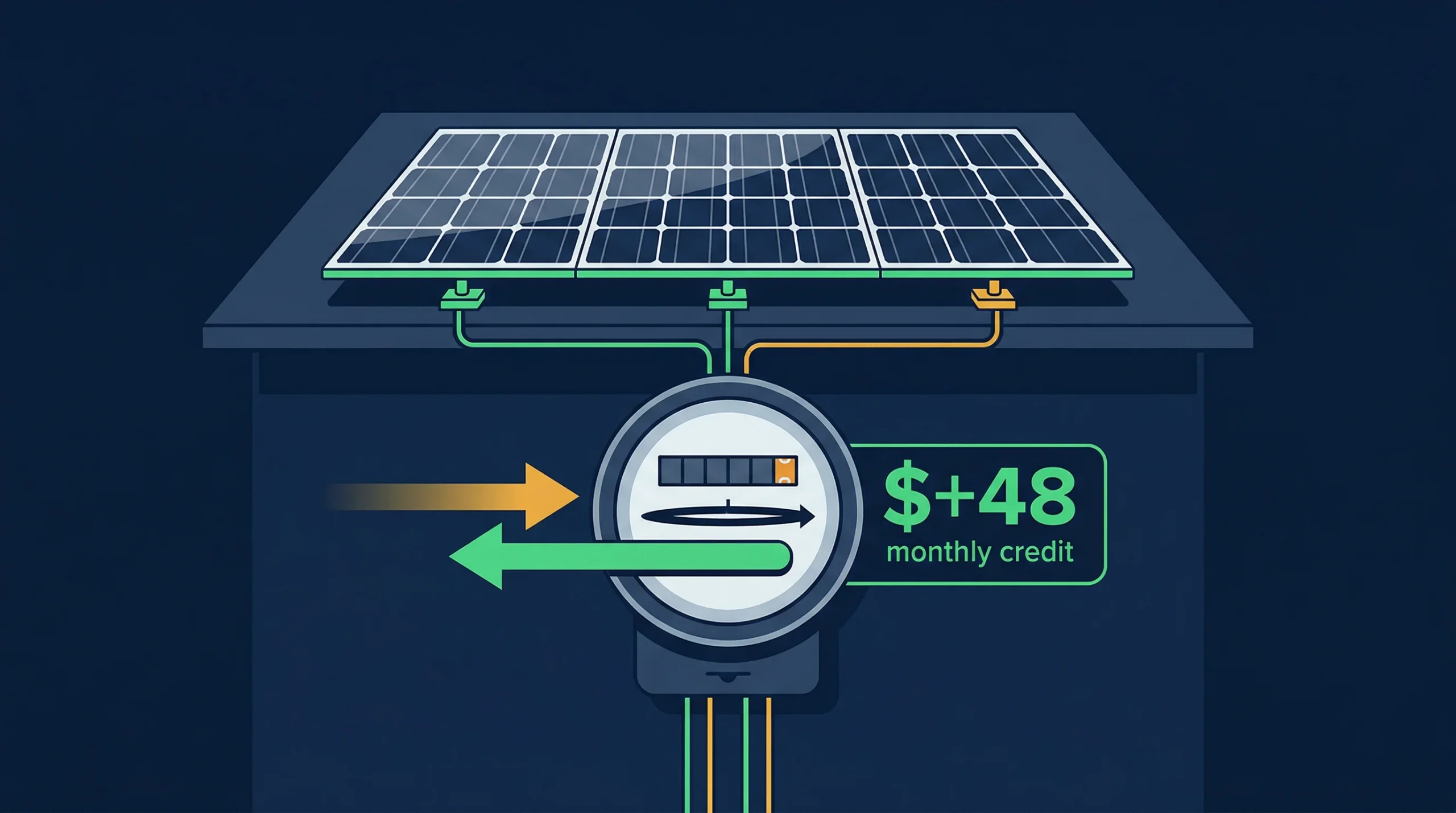
When my sister installed solar panels, she called me confused about her first electricity bill. She had expected it to be much lower. What she had not accounted for was that her system was producing more electricity than her household could use during the day — and her utility was crediting her for the surplus at 8¢ per kWh rather than the 22¢ she paid to import electricity at night.
That 14¢ gap between what she earned on exports and what she paid on imports was costing her about $35 per month in otherwise preventable costs. Once she understood how her utility’s net metering policy worked, she shifted her dishwasher and washing machine to run during peak solar hours — increasing her self-consumption from 45% to 72% and recovering most of that gap.
Net metering is one of the most important and least understood variables in residential solar economics. A net metering calculator helps you quantify exactly what your exported electricity is worth, how your utility’s compensation rate compares to your import rate, and what the dollar impact of different self-consumption rates is on your monthly bill. This guide explains all of it.
The Key Concept:
| Net metering is the billing arrangement that determines how much your utility credits you for electricity your solar panels generate but your home does not immediately use. In full retail-rate net metering states, every exported kWh is worth the same as every imported kWh — your meter effectively runs backwards. In reduced-rate states, exported electricity is credited at a lower wholesale or avoided-cost rate, reducing the effective value of your solar system’s generation. |
📊 DOE: U.S. Department of Energy — Net Metering: How Solar Export Credits Work
📌 Also Read:
What Is Net Metering and How Does It Work?
Net metering (also called net energy metering or NEM) is a utility billing mechanism that allows solar panel owners to receive credit for electricity they generate but do not immediately consume. When your solar panels produce more electricity than your home is using at any given moment — typically during sunny midday hours — the surplus flows back to the grid through your utility meter. Your utility records this export and credits your account.
The billing cycle (usually monthly or annually) nets out your imports against your exports. If you exported 300 kWh and imported 450 kWh in a month, you are billed only for the 150 kWh difference (plus any fixed service charges). In states with full retail-rate net metering, both the import and export are valued at the same rate — making the netting a true dollar-for-dollar exchange.
| 40+ states | Full retail | 3–5¢/kWh | $200–$600/yr |
| have some form of net metering policy | best net metering — 1:1 credit | typical avoided-cost export rate in weak NEM states | typical additional savings from net metering credits |
The Net Metering Calculation — Basic Formula
A net metering calculator works with three variables:
- Your monthly solar generation (kWh) — what your panels produce
- Your monthly electricity consumption (kWh) — what your home uses
- Your utility’s export compensation rate (¢/kWh) — what they pay for surplus
The calculation:
- Self-consumed solar (kWh) = MIN(Generation, Consumption)
- Exported solar (kWh) = MAX(0, Generation − Consumption)
- Net metering credit ($) = Exported kWh × Export rate
- Grid import needed (kWh) = MAX(0, Consumption − Generation)
- Net monthly bill = (Grid import × Import rate) − Net metering credit + Fixed charges
Example: 8kW system generating 900 kWh/month. Home consuming 1,100 kWh/month. Export rate = retail rate (28¢/kWh, California).
- Self-consumed: MIN(900, 1,100) = 900 kWh — all generation used directly
- Exported: MAX(0, 900 − 1,100) = 0 kWh — no surplus this month
- Grid import: MAX(0, 1,100 − 900) = 200 kWh × $0.28 = $56 bill
In this scenario the system covers 82% of consumption and the homeowner pays $56 vs their previous $308 bill — a saving of $252/month. No export credits needed because the system doesn’t produce a surplus.
Now the same home in summer, system generating 1,300 kWh/month:
- Self-consumed: MIN(1,300, 1,100) = 1,100 kWh
- Exported: MAX(0, 1,300 − 1,100) = 200 kWh × $0.28 = $56 credit
- Grid import: 0 kWh — system more than covers consumption
- Net bill: $0 − $56 + $15 fixed charge = −$41 (net metering credit bill)
The $41 credit rolls forward to the next month (in most full retail NEM programmes), offsetting future winter months when generation drops.
Net Metering by State — What Compensation Rate Do You Receive?
The rate at which your utility compensates your exported electricity is the most important variable in any net metering calculation. Here is the state-by-state landscape in 2026:
| State | Import Rate | NEM Policy | Export Rate | Annual NEM Credit (est.) | Rating |
| California | 28¢ | NEM 3.0 (reduced since 2023) | 5–9¢ (avoided cost) | $60–$180/yr | ⚠️ Reduced |
| New Jersey | 17¢ | Full retail NEM | 17¢ | $300–$600/yr | ✅ Full retail |
| Massachusetts | 26¢ | Full retail NEM | 26¢ | $400–$800/yr | ✅ Full retail |
| New York | 24¢ | Full retail NEM | 24¢ | $350–$700/yr | ✅ Full retail |
| Maryland | 15¢ | Full retail NEM | 15¢ | $200–$450/yr | ✅ Full retail |
| Pennsylvania | 14¢ | Full retail NEM | 14¢ | $180–$400/yr | ✅ Full retail |
| Connecticut | 24¢ | Full retail NEM | 24¢ | $350–$700/yr | ✅ Full retail |
| Colorado | 14¢ | Full retail NEM | 14¢ | $180–$380/yr | ✅ Full retail |
| Minnesota | 13¢ | Full retail NEM | 13¢ | $160–$350/yr | ✅ Full retail |
| Oregon | 13¢ | Full retail NEM | 13¢ | $160–$340/yr | ✅ Full retail |
| Florida | 13¢ | Net billing (reduced 2023) | 10–11¢ | $150–$300/yr | ⚠️ Slightly reduced |
| Arizona | 13¢ | NEM 2.0 (full retail) | 13¢ | $160–$320/yr | ✅ Full retail |
| Nevada | 13¢ | NEM 3.0 (reduced post-2023) | 6–8¢ | $80–$160/yr | ⚠️ Reduced |
| Hawaii | 42¢ | Customer Self-Supply (no NEM) | 0¢ export credit | $0 NEM | ❌ No net metering |
| Texas | 13¢ | No state mandate — utility varies | 0–5¢ (some utilities) | $0–$80/yr | ❌ Limited/none |
The California NEM 3.0 change in 2023 was the most significant net metering policy shift in US history — reducing the export compensation rate from full retail (28¢/kWh) to an avoided-cost rate of approximately 5 to 9¢/kWh. This reduced the annual value of net metering credits for California solar homeowners by $200 to $600 per year on average. The impact is partially offset by time-of-use rate optimisation and battery storage — but it is important context for California buyers evaluating their solar economics.
📊 NREL: National Renewable Energy Laboratory — Net Metering Policy Landscape and Compensation Rates 2026
📌 Also Read:
How to Use a Net Metering Calculator — Full Walkthrough
A net metering calculator takes your generation profile, consumption profile, and local policy data and produces a precise annual net metering credit estimate. Here is the step-by-step process:
Step 1 — Find Your Monthly Generation Estimate
Your installer should provide an annual generation estimate broken down by month. This is calculated from your system size, local peak sun hours, roof orientation, and panel efficiency. A typical 8kW system in New Jersey might generate:
| Month | Generation (8kW NJ) | Home Use | Exported | NEM Credit @ 17¢ | Bill Impact |
| January | 520 kWh | 950 kWh | 0 kWh | $0 | Buy 430 kWh from grid |
| February | 620 kWh | 900 kWh | 0 kWh | $0 | Buy 280 kWh from grid |
| March | 820 kWh | 850 kWh | 0 kWh | $0 | Buy 30 kWh from grid |
| April | 960 kWh | 800 kWh | 160 kWh | $27.20 | Bill = $0 + credit rollover |
| May | 1,040 kWh | 780 kWh | 260 kWh | $44.20 | Credit accumulating |
| June | 1,080 kWh | 850 kWh | 230 kWh | $39.10 | Credit accumulating |
| July | 1,100 kWh | 950 kWh | 150 kWh | $25.50 | Credit accumulating |
| August | 1,060 kWh | 920 kWh | 140 kWh | $23.80 | Credit accumulating |
| September | 940 kWh | 840 kWh | 100 kWh | $17.00 | Credit accumulating |
| October | 740 kWh | 860 kWh | 0 kWh | $0 | Using rollover credits |
| November | 540 kWh | 900 kWh | 0 kWh | $0 | Using rollover credits |
| December | 440 kWh | 980 kWh | 0 kWh | $0 | Using rollover credits |
| ANNUAL | 9,860 kWh | 10,580 kWh | 1,040 kWh | $176.80 NEM | Net: buy 720 kWh |
This New Jersey homeowner exports 1,040 kWh per year worth $176.80 in net metering credits. Their system covers approximately 93% of their annual electricity consumption, and the NEM credits offset a significant portion of their winter grid imports.
Step 2 — Know Your Utility’s Export Rate
Your utility’s export rate is not always the same as your import rate. In full retail NEM states (New Jersey, Massachusetts, New York, Connecticut, Pennsylvania), you receive full retail rate on exports — the same 17¢, 26¢, or 24¢/kWh you pay to import. In reduced-rate states (California NEM 3.0, Nevada), you receive a lower avoided-cost rate.
To find your utility’s current export rate: check your utility’s website under ‘solar’ or ‘net metering’, review your solar installation contract (it should specify), or call your utility’s solar department directly.
Step 3 — Calculate Annual Net Metering Credit Value
Multiply your annual exported kWh by your utility’s export rate:
- Annual NEM credit = Annual exported kWh × Export rate
- Example (NJ): 1,040 kWh × $0.17 = $176.80 per year in net metering credits
- Example (CA NEM 3.0): 1,040 kWh × $0.07 = $72.80 per year — significantly less
- Example (full retail, 24¢): 1,040 kWh × $0.24 = $249.60 per year
This credit is applied to your monthly electricity bill automatically by your utility. You do not claim it separately on your tax return — it is simply reflected in your lower or zero electricity bill each month.
Self-Consumption Rate — The Key to Maximising Net Metering Value
The most financially efficient solar setup is one where you maximise self-consumption — using as much of your generated electricity directly in your home rather than exporting it. Here is why this matters so much in states with reduced export rates:
| State / Policy | Import Rate | Export Rate | Value Difference |
| California (NEM 3.0) | 28¢/kWh | 5–9¢/kWh | Exported kWh worth 68–82% LESS than self-consumed |
| Nevada (post-NEM 3.0) | 13¢/kWh | 6–8¢/kWh | Exported kWh worth 38–54% less |
| Texas (no mandate) | 13¢/kWh | 0–5¢/kWh | Exported kWh worth 62–100% less |
| New Jersey (full NEM) | 17¢/kWh | 17¢/kWh | Exported kWh = exactly equal to self-consumed |
| Massachusetts (full NEM) | 26¢/kWh | 26¢/kWh | No difference — full retail both ways |
| New York (full NEM) | 24¢/kWh | 24¢/kWh | No difference — full retail both ways |
In California, a solar kWh you consume yourself is worth 28¢ (the import rate you avoid). A solar kWh you export is worth only 5 to 9¢. That means maximising self-consumption in California is worth 3 to 5 times more than exporting the same electricity. This is why battery storage has become far more financially attractive in California post-NEM 3.0 — a battery captures midday surplus and dispatches it in the evening, turning what would have been a 7¢ export into a 28¢ import avoided.
How to Maximise Your Net Metering Credits — 5 Practical Strategies
1. Right-Size Your System to Your Consumption
The most effective way to maximise net metering value is to size your system to produce approximately 90 to 100% of your annual consumption — not significantly more. An oversized system produces more surplus exports than your net metering credits can efficiently compensate for, especially in reduced-rate states. Our solar savings calculator automatically right-sizes the system based on your actual consumption.
2. Shift Appliance Use to Solar Generation Hours
Running your dishwasher, washing machine, pool pump, and EV charger during peak solar hours (typically 9am to 3pm) increases self-consumption directly. Each kWh you shift from evening to midday is worth your full import rate rather than the export rate — a meaningful difference in reduced-NEM states. Smart home timers or smart plugs (available for $15 to $40 each) make this effortless.
3. Add Battery Storage in Reduced-NEM Markets
In states with poor export compensation (California, Nevada, Texas), home battery storage is the most effective tool for capturing the full value of solar generation. A 13.5kWh Tesla Powerwall or similar stores midday surplus and dispatches it in the evening — converting what would be a 7¢ export into a 28¢ import avoided. In California post-NEM 3.0, battery storage adds $300 to $700 per year in effective additional savings compared to a system without storage.
4. Understand Annual vs Monthly True-Up
Many full-retail NEM programmes offer annual true-up billing — unused monthly credits roll forward and are settled once per year. In these programmes, summer surplus generation offsets winter deficits automatically. If your utility does monthly true-up (credits expire at month end), the timing of your appliance loads becomes more important — you need to use surplus generation within the same month or it is lost.
5. Monitor Your Generation and Consumption
Most modern solar inverters include monitoring apps that show your real-time and historical generation. Tracking your self-consumption rate monthly helps you identify whether your appliance scheduling is working and whether your system is performing as expected. A self-consumption rate below 40% in a reduced-NEM state is a signal to adjust your usage patterns or evaluate battery storage.
Net Metering Calculator: Annual Credit Lookup by System Size and Export Rate
Use this reference table to estimate your annual net metering credit value based on your system’s typical surplus export and your utility’s compensation rate. Assumes 30% of annual generation is exported (a typical figure for a correctly sized system in moderate climate):
| System | Annual Gen. | 30% Exported | @ 5¢/kWh | @ 13¢/kWh | @ 24¢/kWh |
| 5 kW | 7,300 kWh | 2,190 kWh | $110/yr | $285/yr | $526/yr |
| 6 kW | 8,760 kWh | 2,628 kWh | $131/yr | $342/yr | $631/yr |
| 7 kW | 10,220 kWh | 3,066 kWh | $153/yr | $398/yr | $736/yr |
| 8 kW | 11,680 kWh | 3,504 kWh | $175/yr | $455/yr | $841/yr |
| 10 kW | 14,600 kWh | 4,380 kWh | $219/yr | $569/yr | $1,051/yr |
| 12 kW | 17,520 kWh | 5,256 kWh | $263/yr | $683/yr | $1,261/yr |
At the 5¢/kWh rate (California NEM 3.0 approximate), net metering provides a modest $110 to $263 per year in credits. At full retail 24¢/kWh (New York, Connecticut), the same export volume is worth $526 to $1,261 per year. This illustrates why net metering policy is such a critical variable in state-by-state solar economics.
📊 EnergySage: EnergySage — Net Metering: How It Works and What You Get Paid in Each State
Frequently Asked Questions
How does net metering affect my monthly electricity bill?
Net metering reduces your monthly electricity bill by crediting you for surplus solar generation. In months where your panels generate more electricity than you use — typically spring and summer — your net metering credits can eliminate your energy bill entirely and create a credit balance that rolls forward to offset winter months. In full retail NEM states, your annual net metering credit typically adds $200 to $800 per year to your total solar savings on top of the direct self-consumption savings.
What happens to my net metering credits if they exceed my monthly bill?
In most full retail NEM programmes, unused monthly credits roll forward to the next month’s bill. At the end of the annual true-up period, any remaining credits are typically compensated at a lower avoided-cost rate rather than full retail — so very large credit balances at year-end are less valuable than credits used during the year. This is why right-sizing your system to approximately match your annual consumption is financially optimal — it minimises the year-end credit balance that would be settled at a lower rate.
Does net metering still apply if I add a battery?
Yes — a home battery does not eliminate net metering eligibility. However, adding a battery typically reduces the volume of electricity you export (because the battery captures surplus generation instead of sending it to the grid). In reduced-NEM states like California post-NEM 3.0, this is financially advantageous — storing electricity worth 28¢/kWh at import rather than exporting it at 7¢/kWh. In full retail NEM states, the financial case for battery storage is weaker since exported electricity is fully compensated.
What is the difference between net metering and feed-in tariffs?
Net metering and feed-in tariffs (FiTs) both compensate solar owners for exported electricity, but they work differently. Net metering credits exports at (or near) the retail import rate and nets them against your consumption — you only pay for the difference. Feed-in tariffs (common in Germany, UK’s Smart Export Guarantee, and Australia’s feed-in tariffs) pay a fixed rate per kWh exported, regardless of what you pay to import electricity. Some FiTs pay more than the retail rate (early German FiTs), some pay less (UK’s current Smart Export Guarantee at 5–15p/kWh vs 34p import). Net metering is generally more straightforward for residential users; FiTs can sometimes offer better economics in high-rate markets.