

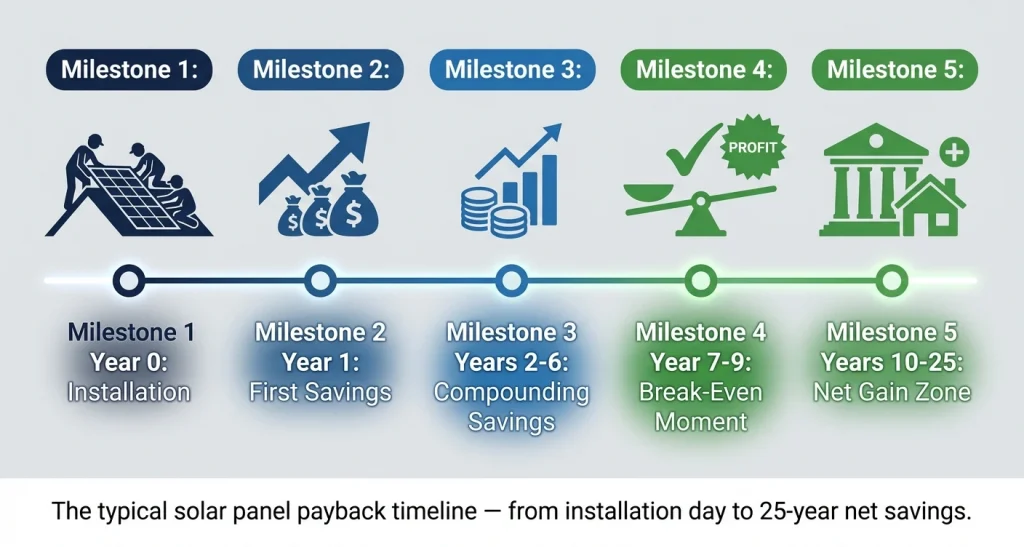
My neighbour David installed solar panels in early 2024. Within eighteen months, he had reduced his monthly electricity bill from $210 to $18 — and he had a cheque from his utility company for net metering credits sitting on his kitchen table when I went to see him. His payback period, based on his net installation cost after the federal tax credit, was going to be just under seven years.
Three doors down, my other neighbour Sarah installed a similar-sized system at roughly the same time. Her bill barely moved. The difference? Her roof faces north and is shaded by a large oak tree for most of the day. Her panels simply cannot generate what David’s can.
Two homeowners. Same street. Same installer. Completely different outcomes. This is the reality of the question are solar panels worth it in 2026 — and it is exactly why the honest answer is not a simple yes or no. It depends on five factors that vary enormously from home to home, and the only way to get the right answer is to understand what those factors are and how they apply to your specific situation.
This guide gives you the complete, unbiased breakdown. No sales pitch. Just the real numbers, the honest conditions under which solar makes excellent financial sense — and the equally important conditions under which it does not.
The Key Insight:
| Whether solar panels are worth it depends almost entirely on five variables: your electricity rate, your local sun hours, your roof’s condition and orientation, the available tax incentives, and how long you plan to stay in your home. Get all five working in your favour, and solar is one of the best investments a homeowner can make. Get one badly wrong, and the maths can fall apart completely. |
📊 U.S. Department of Energy: DOE Solar Energy Technologies Office — 2026 Residential Solar Data
📌 Also Read:
Are Solar Panels Worth It in 2026? The Data-Backed Answer
For the majority of homeowners in the United States, United Kingdom, Australia, and Canada, the answer in 2026 is yes — with meaningful caveats. Solar panel costs have fallen dramatically over the past decade, government incentives remain generous, and rising electricity prices are making the economics more compelling every year.
Here is what the numbers actually look like in 2026 for a typical US homeowner installing an 8kW system:
| $2.80–$3.50/W | 30% | 7–9 years | $40K–$80K |
| Avg. US install cost per watt | Federal tax credit (ITC) | Average payback period | 25-year net savings |
Those are averages. The actual numbers for your home could be significantly better — or significantly worse. Arizona homeowners with south-facing roofs and high electricity rates routinely achieve payback in 5–6 years and net savings of $70,000+ over 25 years. Homeowners in cloudy northern states with low electricity rates might see payback periods of 12+ years and much lower overall returns.
The fastest way to get your personalised numbers is our free solar panel calculator, which uses your exact location, electricity rate, and roof orientation to calculate your real-world savings estimate in under two minutes.
The 5 Factors That Determine Whether Solar Is Worth It For You
After analysing millions of solar estimates across our calculators, these are the five variables that account for nearly all the difference between excellent and poor solar ROI.
1. Your Electricity Rate — The Single Biggest Factor
Your electricity rate is the most powerful driver of solar savings. Every kilowatt-hour your panels generate is one you do not buy from the grid — and the more you pay per kWh, the more valuable that generation is.
In 2026, electricity rates vary enormously across the top-tier markets:
| Location | Avg. Rate/kWh | Solar Savings Impact |
| Hawaii, USA | 42¢ | ⭐⭐⭐⭐⭐ Exceptional |
| California, USA | 28¢ | ⭐⭐⭐⭐⭐ Exceptional |
| United Kingdom | 34p (~43¢) | ⭐⭐⭐⭐ Very Strong |
| New York, USA | 24¢ | ⭐⭐⭐⭐ Very Strong |
| Australia (avg) | 30¢ AUD | ⭐⭐⭐⭐⭐ Exceptional |
| Texas, USA | 13¢ | ⭐⭐⭐ Good |
| Louisiana, USA | 9¢ | ⭐⭐ Moderate — longer payback |
If your electricity rate is above 15¢/kWh, solar is almost certainly financially worthwhile if the other conditions are met. Below 10¢/kWh, the maths becomes more challenging and the payback period extends significantly.
2. Your Local Peak Sun Hours
Peak sun hours measure how many hours of optimal sunlight your location receives per day — the primary driver of how much electricity your panels actually generate. More sun hours means more generation, which means faster payback and higher lifetime savings.
- Arizona, New Mexico: 6.0–6.5 peak sun hours/day — among the highest in the world
- California, Nevada, Florida: 5.0–5.8 hours/day — excellent
- Texas, Georgia, Australia (most): 4.5–5.5 hours/day — very good
- New York, UK Midlands: 3.5–4.5 hours/day — good
- Scotland, Pacific Northwest USA: 2.5–3.5 hours/day — feasible but requires larger system
3. Your Roof — Orientation, Age, and Shading
The best solar economics in the world cannot save a poorly oriented, heavily shaded roof. Before running any financial calculation, do an honest assessment of your roof:
- South-facing (Northern Hemisphere) at 20–35° pitch: optimal — 100% output potential
- Southeast or southwest-facing: very good — roughly 90–95% of south-facing output
- East or west-facing: acceptable — roughly 75–85% of optimal
- North-facing: generally not recommended in the Northern Hemisphere
- Heavy shading from trees, chimneys, or nearby buildings: reduces output by 20–50% — may make solar uneconomical
- Roof under 5 years old: ideal — no replacement needed during panel warranty period
- Roof over 15 years old: consider replacing before solar installation to avoid costly panel removal later
4. Available Tax Credits and Incentives
Government incentives can reduce your net installation cost by 20–50%, dramatically improving the financial case for solar. In 2026, the major incentives are:
| Country/Region | Incentive | Value | Available Until |
| USA | Federal ITC (30%) | $5,000–$9,000 on avg. system | 2032 |
| USA (varies by state) | State rebates + SREC markets | $0–$5,000+ extra | Varies |
| Australia | STC rebates | AUD $2,000–$4,000 | 2030 (reducing) |
| United Kingdom | Zero VAT on install | Saves ~£1,400 on avg. system | No end date set |
| Germany | 20% VAT exemption | Saves ~€2,500 on avg. system | No end date set |
| Spain | 20% rebate (varies by region) | €2,000–€5,000 | Varies by region |
Use our solar tax credit calculator 2026 to calculate your exact federal ITC credit and any applicable state rebates for your location.
5. How Long You Plan to Stay in Your Home
Solar panels have a 25-year performance warranty and typically last 30+ years. The financial case is strongest for homeowners who will stay long enough to capture the full payback period and the profit years beyond it.
When Solar Panels Are Clearly Worth It in 2026
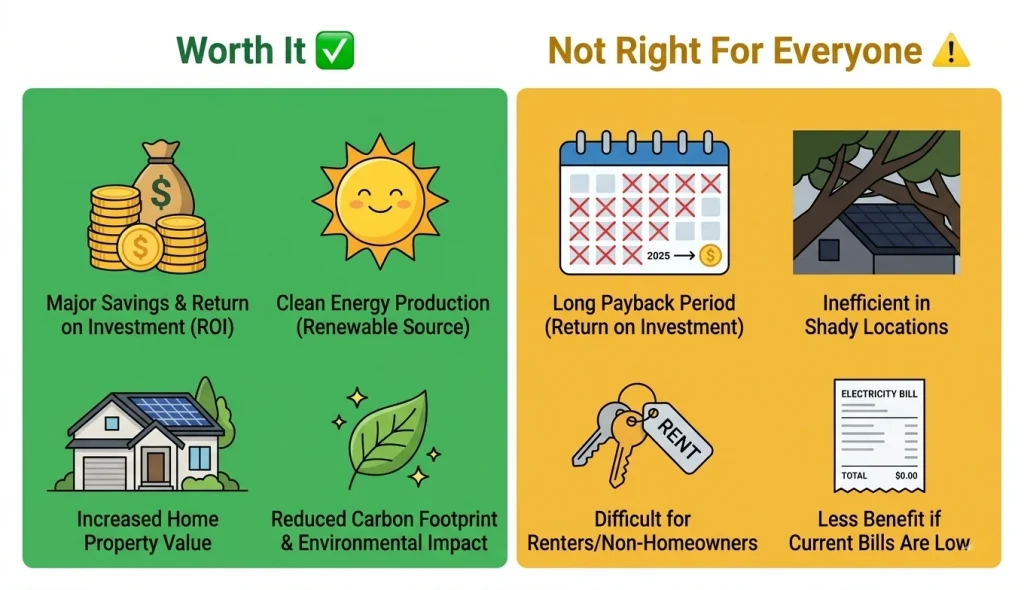
Based on our analysis of millions of estimates, these are the conditions under which solar delivers a clear, strong financial return:
- Your monthly electricity bill is consistently above $100 (US) / £60 (UK) / AUD $150 (Australia). Higher bills mean more savings potential and faster payback.
- You are in a high-sun region: Arizona, California, Nevada, Florida, Texas, Spain, Australia, UAE.
- You own your home and plan to stay 7+ years.
- Your roof faces south, southeast, or southwest with minimal shading.
- You qualify for the 30% US federal ITC or equivalent national incentive — this single credit changes the economics dramatically.
- You have an electric vehicle or are planning to get one — solar + EV dramatically reduces your combined energy costs.
When Solar Panels May NOT Be Worth It
Solar is not the right answer for every homeowner in 2026, and being honest about that is important. Here are the conditions that genuinely undermine the financial case:
- You rent your home — you cannot install panels on a property you do not own without landlord permission, and the financial benefit goes to the owner, not you
- Your electricity rate is very low — below 9¢/kWh (some US states like Louisiana and Wyoming), the payback period extends to 15+ years, making the investment difficult to justify
- Your roof has heavy shading — even 30% shading can extend payback by 3–5 years and significantly reduce lifetime returns
- Your roof needs replacing soon — removing and reinstalling panels for a roof replacement adds $2,000–$4,000 to your costs
- You are moving within 3–5 years — in most markets, you will not reach break-even before the sale
- Your utility has eliminated net metering — some US utilities have significantly reduced export credits, which reduces the value of excess generation substantially
This is not meant to discourage you — it is meant to help you make a genuinely informed decision. Our calculator factors in all these variables automatically.
What Solar Panels Actually Cost in 2026: The Real Numbers
Let us look at what a typical solar installation actually costs — and what you get for it — in the major top-tier markets in 2026.
| Location | Gross Cost (8kW) | After Incentives | Monthly Savings | Payback Period |
| Arizona, USA | $22,400 | $15,680 | $210/mo | 6.2 yrs |
| California, USA | $26,400 | $18,480 | $195/mo | 7.9 yrs |
| Florida, USA | $23,200 | $16,240 | $170/mo | 7.9 yrs |
| New York, USA | $28,000 | $19,600 | $180/mo | 9.1 yrs |
| UK (avg) | £14,400 | £14,400* | £95/mo | 12.6 yrs |
| Australia (avg) | AUD $8,800 | AUD $6,200 | AUD $220/mo | 4.6 yrs |
| Germany | €12,800 | €10,240 | €110/mo | 9.7 yrs |
* UK: zero VAT applied — no direct cash incentive but saves approximately £1,400 on average system. Smart Export Guarantee provides additional export income.
📊 NREL: National Renewable Energy Laboratory — U.S. Solar PV System Cost Benchmark 2026
How to Know If Solar Is Worth It For YOUR Home — 4 Steps
The clearest and fastest way to answer this question is to follow these four steps:
Step 1 — Run a solar calculator. Use our free solar panel calculator with your actual monthly electricity bill, your postcode/ZIP code, and your roof orientation. You will get a personalised estimate of system cost, monthly savings, payback period, and 25-year return in under two minutes.
Step 2 — Check your eligibility for incentives. Confirm whether you qualify for the 30% federal ITC (US) or your country’s equivalent. Use our solar tax credit calculator to calculate your exact credit amount. If you are in the US, also check for state-level rebates and SREC markets in your state.
Step 3 — Honestly assess your roof. Stand outside your home and note the compass direction your main roof faces, estimate the shading from any trees or structures, and check your roof’s age. If your roof is over 15 years old, get a roofing inspection before your solar quotes.
Step 4 — Get at least 3 quotes. Never accept the first quote. Installation costs vary by 30–50% between installers for identical systems. Platforms like EnergySage (US) and Solar Choice (Australia) make it easy to compare quotes in your area. Check our solar panel cost comparison guide for what to look for in an installer quote.
The Solar Investment vs. Other Home Improvements: How Does It Stack Up?
One way to evaluate whether solar is worth it is to compare its return on investment to other common home improvements. Here is how solar compares:
| Home Improvement | Avg. Cost | ROI (25 yr) | Risk Level |
| Solar panels (US avg.) | $15,400 net | $40,000–$80,000 | 🟢 Low |
| Kitchen renovation | $25,000–$50,000 | $10,000–$20,000 | 🟡 Medium |
| Bathroom renovation | $15,000–$30,000 | $8,000–$15,000 | 🟡 Medium |
| New roof | $10,000–$20,000 | $8,000–$12,000 | 🟢 Low |
| Home extension | $60,000–$120,000 | Variable | 🔴 High |
| New HVAC system | $8,000–$15,000 | $5,000–$10,000 | 🟢 Low |
For most homeowners in favourable markets, solar delivers a higher net return than any other home improvement — with the added benefit of reducing your monthly bills immediately, before you even reach break-even.
📊 EnergySage: EnergySage Solar Marketplace — Average Solar Panel Savings Data 2026
Is Solar Worth It in 2026 vs. Previous Years? What Has Changed
The financial case for solar in 2026 is stronger than it has ever been. Here is what has changed since 2020:
- Solar panel prices have fallen 45% since 2020 — the hardware cost of a panel has dropped from $0.50/W to under $0.25/W at the module level
- Battery storage costs have fallen 60% since 2020 — making hybrid and off-grid systems far more accessible
- Grid electricity prices have risen 30–60% in most top-tier markets since 2020 — dramatically improving the savings calculation
- The US 30% federal ITC was extended through 2032 — giving homeowners certainty about the incentive being available
- Installer competition has increased — more installers means more competitive pricing and better consumer choice
- Better panels — modern monocrystalline panels achieve 21–24% efficiency vs 18–20% five years ago, meaning smaller systems can cover the same electricity demand
The 2030 window is particularly important: the US federal ITC begins stepping down after 2032, Australian STC values reduce each year, and some state and utility incentives have already begun to be wound back in high-penetration solar markets. The financial case for solar is strong now and likely to remain strong through 2030 — but the best incentives available today will not be around forever.
📊 IEA: International Energy Agency — Solar PV Market and Technology Update 2026
📌 Also Read:
Frequently Asked Questions
Are solar panels worth it if I have a low electricity bill?
If your monthly electricity bill is consistently below $70–$80 (US), the financial case for solar weakens considerably. With a smaller bill to offset, your annual savings are lower, which extends the payback period. At $50/month, a correctly sized system might take 14–18 years to pay back in an average US location — making it a marginal investment at best. Our solar calculator will show you your exact numbers.
Do solar panels add value to your home?
Yes. Multiple studies — including research from Lawrence Berkeley National Laboratory — show that solar panels increase home resale value by an average of 3–4% in the US. For a $400,000 home, that is $12,000–$16,000 in added value. In the UK, solar homes sell faster and command a premium in energy-efficient property segments. However, the premium varies significantly by market and buyer demographics — rural areas and lower-income areas sometimes show smaller premiums.
Is it better to buy solar panels outright or get a solar loan?
Buying outright gives you the highest lifetime return — you own the system from day one, qualify for the full 30% tax credit immediately, and capture 100% of the savings. A solar loan is the next best option: you still own the system and qualify for the tax credit, and monthly payments are often less than your current electricity bill from day one. Solar leases and PPAs are the least financially beneficial option — you do not own the panels, do not qualify for the tax credit, and the savings are lower.
How accurate are solar savings calculators?
A good solar savings calculator — one that uses your real location data, local electricity rate, and roof orientation — is typically accurate within 10–20% of a professional installer quote. They are excellent for making a confident go/no-go decision before requesting quotes. Our calculator uses NREL solar irradiance data and 2026 pricing benchmarks for accuracy. For a binding cost and production estimate, you will need a professional site assessment.