
Last spring a homeowner contacted our site after receiving her final solar invoice. The total was $26,800. She knew about the 30% federal tax credit but was not sure exactly how to calculate it — specifically whether it applied to the full $26,800, whether the $1,400 battery she had added was included, and what would happen since her normal federal tax bill was only around $4,200 per year.
These are exactly the right questions to ask — and they are questions that generic ‘just multiply by 30%’ articles do not answer properly. Her credit was $8,040 on the full $26,800. She would use $4,200 of it in year one and carry forward $3,840 to year two. In year two her remaining credit would reduce her tax bill to zero and put $200 in additional carryforward. By year three the full credit would be used.
This guide walks through the complete calculation method — every step, every variable, five different worked scenarios — so you know exactly what your credit is and exactly how it flows through your tax return.
The Core Formula:
| Solar ITC Credit = Total Qualifying Installation Cost × 30%. The credit applies to your full installed system cost including panels, inverter, labour, permits, wiring, and battery storage. You then compare the credit to your federal income tax liability for the year — using as much as you can in year one and rolling the rest forward. |
📊 IRS: IRS Form 5695 — Official Instructions for Residential Energy Credits 2026
📌 Also Read:
The Solar Tax Credit Calculation: A Plain-English Overview
Calculating your federal solar tax credit involves three numbers and one comparison. Here is the summary before we go through each step in detail:
| Step 1 | Step 2 | Step 3 | Step 4 |
| Find your total qualifying cost | Multiply by 30% | Compare to your tax liability | Claim on Form 5695 |
The formula itself is simple. What makes it complex for some homeowners is knowing exactly which costs to include (labour and permits, yes; roof replacement, no), understanding the difference between tax liability and withholding, and knowing what happens when the credit exceeds your liability in a given year.
We will cover all of these — and work through five real scenarios at the end to show how the calculation plays out across different homeowner situations.
For a quick automated calculation, use our solar tax credit calculator — enter your system cost and it does the maths instantly.
Step 1 — Identify Your Total Qualifying Solar Costs
Your credit calculation starts with a single number: the total qualifying cost of your solar installation. This comes from your final installer invoice — but not every line item on that invoice necessarily qualifies.
What to Include
Add up every cost that is directly part of installing and operating your solar energy system:
- Solar photovoltaic panels — all wattages and brands qualify
- Inverter — string inverter, microinverters, or power optimisers
- Mounting hardware and racking system — roof or ground mount
- All labour and installation charges — including subcontractor work
- Electrical wiring, conduit, disconnect switches, and junction boxes
- Monitoring system hardware — if supplied as part of the installation
- Permit fees and inspection costs — included in the project total
- Utility interconnection fees — if paid as part of the installation
- Battery storage system — if installed simultaneously or separately (must be 3kWh+ capacity)
What to Exclude
Do not include these costs in your qualifying total:
- Roof replacement or major structural repairs — unless specifically and only needed to support the solar mount
- Extended service or maintenance contracts — ongoing service is not a qualifying installation cost
- Solar lease or PPA payments — you must own the system to claim the credit
- Landscaping or tree removal — even if trees are removed to reduce shade on panels
- Home automation systems — unless integrated directly into the solar energy management system
| Example Invoice Item | Qualifies? | Amount |
| 24× SunPower 400W panels | ✅ Yes | $8,640 |
| SolarEdge HD Wave 7.6kW inverter | ✅ Yes | $2,200 |
| IronRidge XR100 racking system | ✅ Yes | $1,800 |
| Labour — installation crew (3 days) | ✅ Yes | $5,400 |
| Electrical panel upgrade (200A) | ✅ Yes | $2,200 |
| Conduit, wiring, DC disconnect | ✅ Yes | $1,100 |
| City building permit | ✅ Yes | $620 |
| Utility interconnection fee | ✅ Yes | $350 |
| SolarEdge monitoring subscription | ❌ No | $120/yr |
| Roof shingle replacement (5 squares) | ❌ No | $3,200 |
| QUALIFYING TOTAL | → | $22,310 |
In this example, the homeowner correctly excludes the monitoring subscription and the roof work — reducing their qualifying total to $22,310 rather than the full invoice of $25,630. Their credit is calculated only on the $22,310.
Step 2 — Multiply Your Qualifying Cost by 30%
Once you have your qualifying cost, the credit calculation is a single multiplication:
The Formula:
| Credit Amount = Qualifying Installation Cost × 0.30 |
Using our example: $22,310 × 0.30 = $6,693 federal solar tax credit.
For round numbers at common system sizes in 2026:
| Qualifying System Cost | × 30% | = Your Credit | Net Cost After Credit |
| $12,000 | × 0.30 | $3,600 | $8,400 |
| $15,000 | × 0.30 | $4,500 | $10,500 |
| $18,000 | × 0.30 | $5,400 | $12,600 |
| $20,000 | × 0.30 | $6,000 | $14,000 |
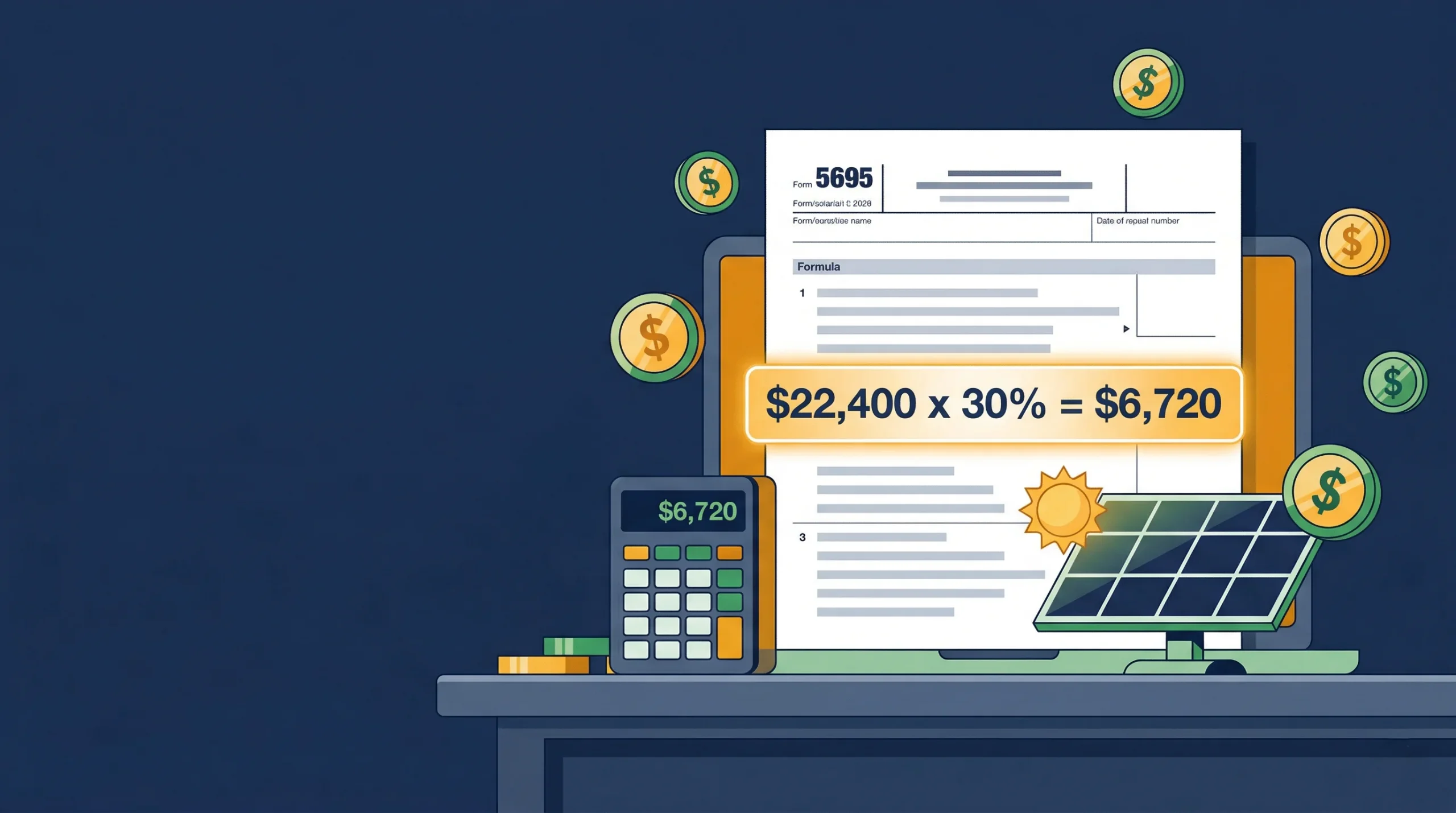
| $22,400 | × 0.30 | $6,720 | $15,680 |
| $24,000 | × 0.30 | $7,200 | $16,800 |
| $28,000 | × 0.30 | $8,400 | $19,600 |
| $34,000 | × 0.30 | $10,200 | $23,800 |
| $38,000 | × 0.30 | $11,400 | $26,600 |
Step 3 — Find Your Federal Tax Liability
This is the step where many homeowners get confused — and the confusion usually comes from mixing up two different numbers that both appear on their tax return.
Tax Liability vs Tax Owed After Withholding
Your federal income tax liability is the total federal income tax you owe based on your income before any withholding payments are credited. It appears on Line 24 of Form 1040, labelled ‘Tax’.
This is different from the ‘Amount you owe’ or ‘Refund’ that appears at the bottom of your 1040 — those numbers reflect your liability minus what was already withheld from your pay throughout the year.
Example: If Line 24 (Tax) shows $8,500 and your withholding was $9,200, you would normally receive a $700 refund. Your tax liability for ITC purposes is $8,500 — not $0 because you are getting a refund.
Why This Matters for Your Credit
Your solar ITC can reduce your federal tax liability (Line 24) to zero — but it cannot go below zero. If your credit exceeds your Line 24 liability, the excess carries forward to next year. Use your most recent tax return to find your approximate Line 24 liability:
- Line 24 of Form 1040 — ‘Tax’: this is your base federal income tax liability before credits
- If you pay quarterly estimated taxes, add those amounts to understand your gross liability
- Most tax software shows this as ‘Total Tax’ before non-refundable credits are applied
| Approximate Income Level | Typical Fed. Tax Liability (2026) | Notes on ITC Use |
| $50,000 (single) | $4,500–$6,000 | May need 2-year carryforward for large system |
| $75,000 (single) | $8,000–$10,500 | Likely uses full credit in one year |
| $100,000 (married filing jointly) | $10,000–$14,000 | Full credit usable year 1 for most system sizes |
| $150,000 (married filing jointly) | $18,000–$24,000 | Full credit used year 1, even for large systems |
| $200,000+ (married filing jointly) | $28,000+ | Full credit used year 1 in all scenarios |
These are rough guideposts only — your actual liability depends on deductions, other credits, filing status, and income composition. Your previous year’s Form 1040 is the most reliable reference.
Step 4 — Determine What You Claim in Year One vs Carry Forward
Once you know your credit amount and your tax liability, the year-one and carryforward calculation is straightforward:
Year 1 Credit Used:
| MIN(Credit Amount, Federal Tax Liability) |
Carryforward to Year 2:
| Credit Amount − Year 1 Credit Used |
Three scenarios:
| Credit Amount | Year 1 Tax Liability | Year 1 Used | Carryforward | Year 2 Liability | Year 2 Used |
| $6,720 | $10,000 | $6,720 | $0 | — | Credit fully used in Year 1 |
| $6,720 | $6,720 | $6,720 | $0 | — | Credit exactly used in Year 1 |
| $6,720 | $4,200 | $4,200 | $2,520 | $8,000 | $2,520 used in Year 2 |
| $9,600 | $4,500 | $4,500 | $5,100 | $4,800 | $4,800 used, $300 to Year 3 |
| $11,400 | $5,000 | $5,000 | $6,400 | $5,500 | $5,500 used, $900 to Year 3 |
The carryforward is automatic — your tax software or preparer tracks it on Form 5695 each year until the full credit is used. There is no penalty, no application, and no time pressure — the unused credit simply waits for you on next year’s return.
Step 5 — File IRS Form 5695
Your solar tax credit is claimed on IRS Form 5695 (Residential Energy Credits). Here is exactly what to do:
Part I — Residential Clean Energy Credit
On Form 5695 Part I, you complete the following:
- Line 1: Enter the total qualifying cost of your solar installation (your Step 1 number)
- Line 6b: This calculates to 30% of Line 1 — your credit amount (your Step 2 number)
- Line 12: Enter any credit carryforward from a previous year
- Line 13: Total credit available (Line 6b + Line 12)
- Lines 14–16: Calculate how much applies this year based on your tax liability (your Step 3/4 comparison)
- Line 16: Carryforward to next year — this amount goes on next year’s Form 5695
How It Flows to Your 1040
The Form 5695 credit amount flows to Schedule 3 (Additional Credits and Payments), Line 5. Schedule 3 then feeds into Form 1040, Line 20 — reducing your total tax liability. Your tax software handles this automatically; you simply enter the Form 5695 data and the credit flows through the return without any additional manual steps.
Using Tax Software
All major tax preparation software — TurboTax, H&R Block, TaxAct, FreeTaxUSA, Credit Karma Tax — includes a guided solar energy credit section. When you reach the ‘Credits’ section, look for ‘Residential Energy Credits’ or ‘Form 5695’. The software will ask for your installation date and total cost, then calculate and apply the credit automatically. Most homeowners complete this in under 5 minutes.
📊 DOE: U.S. Department of Energy — Official Guide to Claiming the Federal Solar Tax Credit
📌 Also Read:
Five Worked Examples: Solar ITC Calculation for Real Homeowner Scenarios
Here are five complete worked examples covering different system sizes, tax situations, and financing arrangements — the most common scenarios we see from homeowners using our calculator.
Example 1 — Average 8kW System, Single Homeowner, Full Credit in Year 1
| Variable | Amount |
| Total qualifying installation cost | $23,200 |
| Credit calculation | $23,200 × 30% = $6,960 |
| Homeowner’s federal tax liability (Line 24) | $9,400 |
| Credit used in Year 1 (min of credit and liability) | $6,960 |
| Carryforward to Year 2 | $0 |
| Net system cost after credit | $23,200 − $6,960 = $16,240 |
| Monthly electricity saving (Florida, 13¢/kWh) | $145–$185/mo |
| Payback period | 7.4 years |
Example 2 — 10kW System + Battery, Married Couple, Large Credit
| Variable | Amount |
| Solar system cost (10kW) | $28,400 |
| Battery storage cost (13.5kWh Tesla Powerwall 3) | $12,400 |
| Total qualifying cost | $40,800 |
| Credit calculation | $40,800 × 30% = $12,240 |
| Federal tax liability (joint return, $185,000 income) | $22,600 |
| Credit used in Year 1 | $12,240 (full credit — liability exceeds credit) |
| Carryforward | $0 |
| Net combined cost (solar + battery) after credit | $40,800 − $12,240 = $28,560 |
Example 3 — Moderate Income, Credit Exceeds Liability, 2-Year Carryforward
| Variable | Amount |
| Qualifying installation cost | $19,600 |
| 30% credit | $5,880 |
| Year 1 tax liability | $3,200 |
| Year 1 credit used | $3,200 |
| Carryforward to Year 2 | $2,680 |
| Year 2 tax liability | $3,400 |
| Year 2 credit used | $2,680 (carryforward — all used) |
| Total credit used over 2 years | $5,880 — full amount |
| Net system cost after full credit | $19,600 − $5,880 = $13,720 |
Example 4 — Retiree with Low Income, 3-Year Carryforward
| Variable | Amount |
| Qualifying installation cost | $16,800 |
| 30% credit | $5,040 |
| Year 1 tax liability | $1,800 (Social Security + small IRA withdrawal) |
| Year 1 credit used | $1,800 |
| Year 2 carryforward / liability / used | $3,240 carried → $1,900 liability → $1,900 used |
| Year 3 carryforward / liability / used | $1,340 carried → $2,100 liability → $1,340 used |
| All credit used by Year 3 | ✅ Full $5,040 claimed over 3 years |
| Net system cost after full credit | $16,800 − $5,040 = $11,760 |
Example 5 — Standalone Battery Added 2 Years After Solar
| Variable | Amount |
| Solar installed | 2024 — ITC already claimed on solar |
| Battery installed | 2026 — separate installation, separate credit |
| Battery cost (Enphase IQ Battery 10T) | $10,800 installed |
| 30% credit on battery alone | $10,800 × 30% = $3,240 |
| Year 1 tax liability (2026) | $7,600 |
| Credit used in 2026 | $3,240 — full battery credit (liability exceeds credit) |
| Carryforward | $0 |
| Net battery cost after credit | $10,800 − $3,240 = $7,560 |
Example 5 is particularly important — many homeowners do not realise that adding a battery years after the original solar installation generates its own separate 30% credit. This has been the case since the Inflation Reduction Act of 2022 expanded standalone battery eligibility.
How State Rebates Affect Your Federal ITC Calculation
If you receive a state rebate or utility rebate, there is an important question: does the rebate reduce your qualifying cost for the federal ITC? The answer depends on how and when the rebate is paid.
Rebates Paid Directly to Your Installer
Many utility and state rebates are paid directly to the installer, who then passes the savings to you through a reduced invoice price. In this case, your qualifying cost for the federal ITC is simply the net amount you paid after the rebate — the rebate has already reduced your basis.
Example: $22,000 system with a $2,000 utility rebate paid to installer. You pay $20,000. Your ITC qualifying cost is $20,000. Credit = $6,000.
Rebates Paid Directly to You
Some state programmes pay rebates directly to the homeowner after installation. In this case, the IRS treatment is more nuanced. The rebate may or may not reduce your basis depending on whether it is classified as a purchase price reduction or as income. For rebates paid directly to you, consult a tax professional to determine the correct federal ITC calculation — the answer can meaningfully affect your credit amount.
SREC and Net Metering Income Does Not Affect the ITC
Income you earn from selling solar renewable energy certificates (SRECs) or from net metering credits is treated as regular taxable income (or an offset to electricity costs) — it does not reduce your qualifying cost for the ITC calculation. You calculate your ITC on your full installation cost regardless of any SREC income you may earn in subsequent years.
Frequently Asked Questions
Does the 30% solar tax credit apply to the total invoice including VAT or sales tax?
In states that do not have a solar sales tax exemption, any sales tax paid on solar equipment or installation labour is included in your qualifying cost and does qualify for the 30% federal ITC. Your total qualifying cost includes all amounts paid to complete the installation — including applicable sales taxes. In states with solar sales tax exemptions (Arizona, Florida, Texas, and others), no sales tax is charged on the installation, so this does not apply.
Can I calculate the credit before my system is installed?
Yes — and it is useful to do so before signing your installation contract. Ask your installer for an itemised quote showing each cost component. Sum the qualifying items (panels, inverter, labour, permits, wiring, battery if applicable) and multiply by 30% to get your projected credit. This figure will be accurate as long as the final invoice matches the quote — most installers honour their written quotes unless scope changes occur during installation.
What if I paid for my solar system partly in cash and partly with a loan?
Your qualifying cost is the total installation cost — not just the portion you paid in cash. If you put $5,000 down and financed $17,000 with a solar loan, your qualifying cost is $22,000 and your 30% credit is $6,600. The credit applies to the full cost of purchasing and installing the system, regardless of how you structured the payment.
Can I calculate the credit if my system is not yet operational?
You can calculate the expected credit at any time using your installation quote. However, you cannot claim the credit on your tax return until the system is installed and operational — generating electricity — before December 31 of the tax year you file for. If your installation is scheduled for December, confirm with your installer that the system will be commissioned (connected, tested, and producing power) before year-end to qualify for that tax year.