
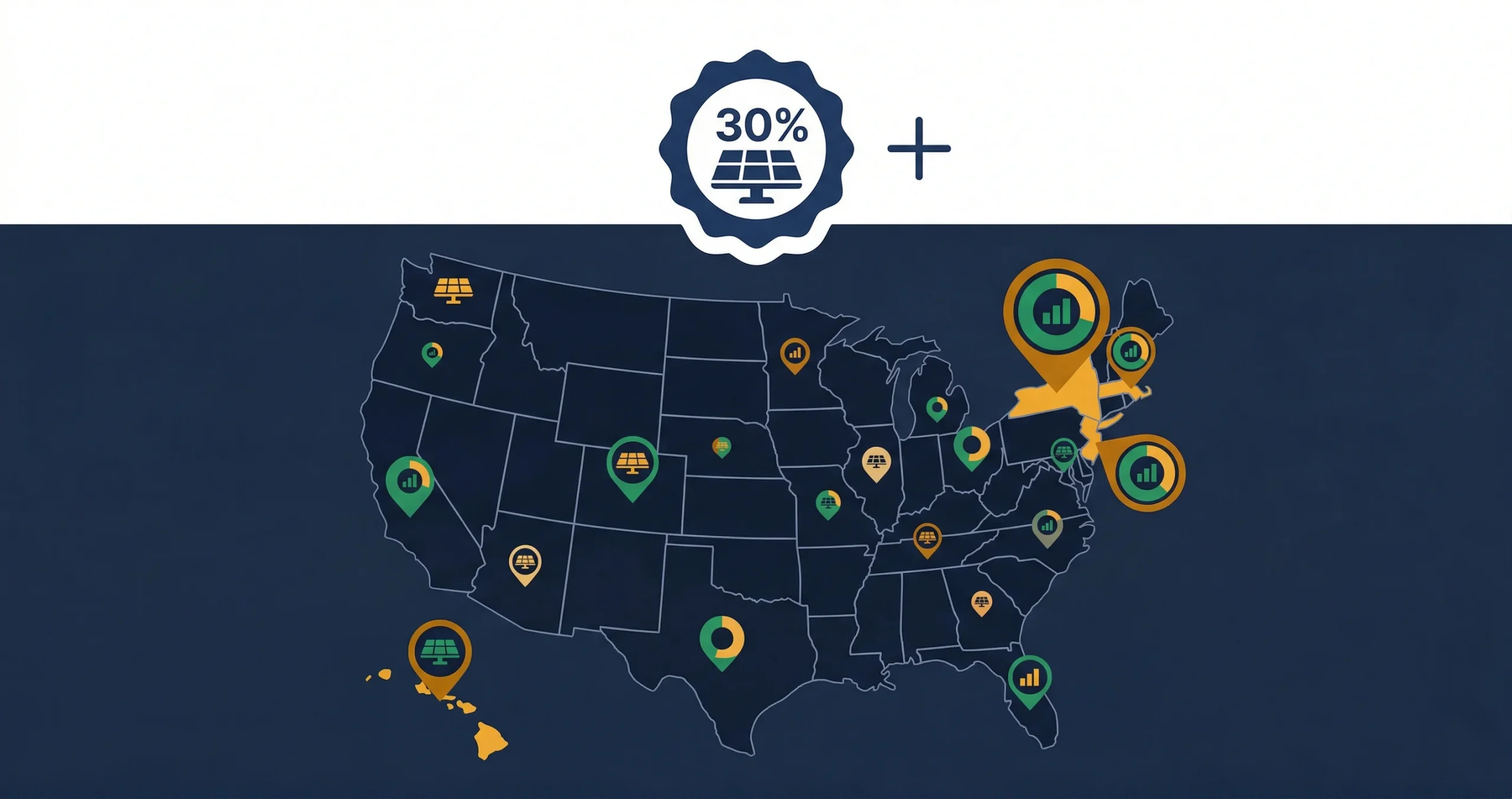
When two homeowners in different states install identical 8kW solar systems for the same gross cost, they can end up with dramatically different net costs — not because of anything they did differently, but because of where they live.
A homeowner in New York who stacks the federal 30% ITC with the NY-Sun rebate, the state tax credit, and a net metering programme can reduce their net installation cost to under $10,000. A homeowner in a state with no additional incentives beyond the federal credit might pay $15,680 for the same system. Same panels. Same installer quality. A $5,680 difference — purely from knowing and claiming their state’s incentive stack.
This guide covers every significant state solar rebate, tax credit, SREC programme, and property tax exemption available in 2026. For each state, we show what stacks on top of the federal 30% ITC and what the combined net cost impact is on a typical 8kW system.
The Key Principle:
| The federal 30% ITC is the baseline that every US homeowner can claim. State-level incentives stack on top of it — and in the best states (New York, Hawaii, Massachusetts, New Jersey, Illinois), the combined federal plus state incentive package can reduce your net installation cost by 50 to 70% of the gross price. Always check your full incentive stack before signing an installation contract. |
📊 DSIRE: Database of State Incentives for Renewables and Efficiency — Complete State Listings
📌 Also Read:
The 4 Types of State Solar Incentives — How They Work
Before looking at specific states, understanding the four types of incentives helps you evaluate what each state offers and how they interact with the federal ITC.
1. State Income Tax Credits
Several states offer a state-level income tax credit that works identically to the federal ITC — you deduct a percentage of your installation cost from your state income tax liability. These credits stack directly with the federal 30% and can reduce your net cost significantly. Notable examples: Hawaii (35%, capped at $5,000), South Carolina (25%, capped at $35,000), Montana (100%, capped at $500), Maryland (30%, capped at $1,000).
2. Direct Cash Rebates
Some states and utilities offer direct cash rebates — a lump sum paid to you or your installer based on system size or capacity. These reduce your upfront out-of-pocket cost directly. The NY-Sun programme offers approximately $1/watt rebate on the first 25kW. Connecticut’s Green Bank offers income-tiered rebates. These rebates may or may not reduce your federal ITC qualifying cost depending on how they are paid (see the previous article for the interaction rules).
3. SREC Programmes (Solar Renewable Energy Certificates)
In states with SREC markets, your solar system generates one SREC for every 1,000 kWh of electricity it produces. You can sell these certificates to utilities who need them to meet renewable energy mandates. SREC income is ongoing — you earn it year after year for the life of your system. States with active SREC markets include New Jersey, Massachusetts, Maryland, Pennsylvania, Ohio, and Illinois. SREC values fluctuate with market demand — current prices range from $10 to $350 per SREC depending on state.
4. Property Tax Exemptions
Most states with solar property tax exemptions prevent local assessors from adding the value of your solar installation to your property’s taxable assessment. Without this exemption, a $22,000 solar system that increases your home’s value by $18,000 would increase your annual property tax bill by $180 to $540 depending on your local tax rate. With the exemption, that increase is protected. States with solar property tax exemptions include Arizona, Florida, Texas, California, New Jersey, Massachusetts, and 30+ others.
Solar Rebate by State 2026 — Complete National Reference Table
Here is the comprehensive state-by-state solar incentive reference for 2026. The ‘Total Incentive Value’ column shows the estimated combined impact of all state incentives on top of the federal 30% ITC for a typical 8kW system costing $24,000 gross ($7,200 federal ITC already applied):
| 30%+ | Up to 35% | $1/W | $350/SREC |
| Federal ITC every state can claim | Best state credit (Hawaii) | NY-Sun direct rebate rate | Top NJ SREC market value |
| State | Fed. ITC | Key State Incentive | State Value | Total Net Cost (8kW) | Rating |
| 🏆 New York | $7,200 | NY-Sun $1/W + state 25% credit | $8,000–$10,000 | $8,000–$12,000 | ⭐⭐⭐⭐⭐ |
| 🏆 Hawaii | $7,200 | State ITC 35% (cap $5,000) | Up to $5,000 | $8,600–$11,800 | ⭐⭐⭐⭐⭐ |
| 🏆 Massachusetts | $7,200 | SMART programme + state credit | $3,000–$6,000+ | $11,000–$14,000 | ⭐⭐⭐⭐⭐ |
| 🏆 New Jersey | $7,200 | SREC income + no sales tax | $2,000–$8,000+ | $9,000–$15,000 | ⭐⭐⭐⭐⭐ |
| 🏆 Illinois | $7,200 | Illinois Shines SRECs | $2,000–$6,000 | $11,000–$15,000 | ⭐⭐⭐⭐⭐ |
| South Carolina | $7,200 | State credit 25% (cap $35,000) | Up to $6,000 | $10,800–$14,000 | ⭐⭐⭐⭐ |
| Maryland | $7,200 | State credit 30% (cap $1,000) + SREC | $1,000–$4,000 | $11,800–$15,800 | ⭐⭐⭐⭐ |
| Montana | $7,200 | State credit 100% (cap $500) | Up to $500 | $16,300 | ⭐⭐⭐⭐ |
| Connecticut | $7,200 | Green Bank rebate (income-tiered) | $0–$10,800 | $8,000–$16,800 | ⭐⭐⭐⭐ |
| Minnesota | $7,200 | Made in Minnesota rebate + PACE | $500–$2,500 | $14,300–$16,300 | ⭐⭐⭐⭐ |
| Pennsylvania | $7,200 | SREC income | $500–$3,000 | $13,800–$16,300 | ⭐⭐⭐⭐ |
| Oregon | $7,200 | Oregon Residential Energy Tax Credit | $1,500–$6,000 | $10,800–$15,300 | ⭐⭐⭐⭐ |
| California | $7,200 | Property tax exempt + net metering | Property savings | $16,800 | ⭐⭐⭐ |
| Arizona | $7,200 | Prop tax exempt + sales tax exempt | $1,000–$2,000 eff. | $14,800–$15,800 | ⭐⭐⭐ |
| Florida | $7,200 | Property tax exempt + sales tax exempt | $1,000–$2,000 eff. | $14,800–$15,800 | ⭐⭐⭐ |
| Texas | $7,200 | Property tax exempt | $400–$1,500 eff. | $15,300–$16,400 | ⭐⭐⭐ |
| Nevada | $7,200 | Property tax exempt | $400–$1,200 eff. | $15,600–$16,400 | ⭐⭐⭐ |
| Colorado | $7,200 | Xcel Energy rebate + PACE loans | $500–$1,500 | $15,300–$16,300 | ⭐⭐⭐ |
| Virginia | $7,200 | Property tax exempt (some counties) | $200–$800 | $15,000–$16,600 | ⭐⭐⭐ |
| Georgia | $7,200 | Property tax exempt | $300–$1,000 | $15,800–$16,500 | ⭐⭐⭐ |
| Texas (rural) | $7,200 | Federal ITC only (no state income tax) | $0 extra | $16,800 | ⭐⭐ |
| Ohio | $7,200 | SREC market (low value) + prop tax | $200–$1,000 | $15,800–$16,600 | ⭐⭐ |
| Indiana | $7,200 | Federal ITC only | $0 extra | $16,800 | ⭐⭐ |
| Louisiana | $7,200 | Federal ITC only | $0 extra | $16,800 | ⭐ |
| Wyoming | $7,200 | Federal ITC only | $0 extra | $16,800 | ⭐ |
* Net costs are estimates for an 8kW system with $24,000 gross cost after the 30% federal ITC ($16,800 baseline), with state incentives applied. Actual values depend on system cost, local tax rates, SREC market prices at time of sale, and individual tax situations. Always verify current incentive availability with your state’s energy office and DSIRE.
📊 EnergySage: EnergySage — State Solar Incentives Guide: Every Programme in 2026
Deep Dive: The 5 States With the Best Incentive Stacks in 2026
1. New York — The Most Generous Combined Incentive Package in the US
New York offers the most powerful combined incentive stack of any US state in 2026. The NY-Sun Megawatt Block programme provides a direct rebate of approximately $1.00 per watt on residential systems — reducing a $24,000 8kW installation by $8,000 before the federal ITC is even applied. On top of that, New York state allows a 25% state income tax credit (capped at $5,000) that stacks with the federal 30% credit.
Combined impact on a $24,000 8kW system:
- Federal ITC 30%: −$7,200
- NY-Sun $1/W rebate: −$8,000
- NY state 25% credit (on net after rebate, capped $5,000): −$4,000
- Net cost: approximately $4,800 to $8,000 depending on exact incentive values and caps
New York also has no sales tax on residential solar installations and a full property tax exemption for the added home value. For a high-electricity-cost state (24¢/kWh average), this produces one of the shortest payback periods of any major market in the country.
Note: NY-Sun rebate values vary by utility territory and remaining programme budget. Always confirm current rates at nyserda.ny.gov
2. Hawaii — Highest State Tax Credit Rate in the US
Hawaii has the highest electricity rates in the US at 42¢/kWh — making solar savings exceptional regardless of incentives. But the state also offers one of the most generous state income tax credits: 35% of the system cost, capped at $5,000 per residential installation. This stacks directly with the federal 30% ITC.
Combined impact on a $24,000 8kW system:
- Federal ITC 30%: −$7,200
- Hawaii state ITC 35% (capped at $5,000): −$5,000
- Net cost: $11,800 — less than half the gross installation cost
Hawaii also has a property tax exemption for solar and no sales tax on solar installation labour. The combination of exceptional solar savings (42¢/kWh × high sun hours = $280–$340/month savings) and the deep incentive stack makes Hawaii one of the world’s best solar markets for homeowners.
3. Massachusetts — The SMART Programme + Multiple Incentives
Massachusetts offers one of the most comprehensive incentive ecosystems in the US. The SMART (Solar Massachusetts Renewable Target) programme provides a guaranteed per-kWh payment for 10 years for every kilowatt-hour your solar system produces — on top of the electricity savings from your own consumption and net metering.
At current SMART rates, a typical 8kW system in Massachusetts generates approximately $150 to $350 per year in SMART programme payments for 10 years — totalling $1,500 to $3,500 in additional income over the programme period. Massachusetts also offers:
- State income tax credit: 15% of installation cost (capped at $1,000)
- Solar property tax exemption: full exemption
- No sales tax on solar equipment
- Strong net metering policy
The SMART programme is administered through the utility. Your installer should enroll you automatically — but confirm this is included in the installation contract.
4. New Jersey — The SREC Market Leader
New Jersey has the most active and valuable SREC market in the US. Solar Renewable Energy Certificates in NJ currently trade at $150 to $350 per certificate — and your 8kW system generates approximately 9 to 11 SRECs per year. That translates to $1,350 to $3,850 per year in additional income from SREC sales, on top of your electricity savings.
At the high end, a New Jersey homeowner with a well-performing system could earn $3,500 to $4,000 per year from SRECs alone in favourable market conditions — dramatically accelerating the payback period and lifetime return. NJ also has:
- No state sales tax on solar equipment or installation
- Property tax exemption for the added home value from solar
- Solar Landscape Initiative additional rebate programmes for low-income households
SREC values fluctuate — they can drop significantly if too many solar systems come online and flood the market. New Jersey has historically maintained high SREC values but it is prudent to model a conservative scenario (say $100–$150/SREC) when evaluating your investment.
5. Illinois — Illinois Shines SREC Programme
Illinois launched the Illinois Shines Adjustable Block Programme in 2019 and it remains one of the most valuable state solar incentive programmes in the Midwest. The programme provides upfront Renewable Energy Credits (RECs) that are worth $2,000 to $6,000 on a typical residential installation — paid via the installer as a reduction in your net system cost.
Unlike New Jersey’s ongoing SREC market, Illinois Shines provides the incentive value upfront as a block payment at the time of installation — making the financial impact immediate and certain. Illinois also has a property tax freeze for solar that prevents the installation from increasing your annual property tax assessment for 4 years.
📌 Also Read:
Property Tax Exemptions and Sales Tax Exemptions by State
These automatic exemptions do not require a tax return filing or application — they are applied either at point of sale or by your county assessor automatically in qualifying states. They do not generate a direct cash payment but represent meaningful long-term savings.
States With Solar Property Tax Exemptions
A solar property tax exemption prevents your county assessor from adding the value of your solar installation to your property’s assessed value. This protects you from higher annual property tax bills after installation:
| State | Exemption Type | Annual Tax Savings (est.) |
| Arizona | Full exemption — solar value excluded from assessment | $200–$600/yr |
| California | New construction exemption (active solar) | $300–$900/yr |
| Florida | Full exemption | $200–$600/yr |
| Texas | Full exemption | $300–$800/yr |
| Nevada | Full exemption | $200–$500/yr |
| New Jersey | Full exemption | $300–$800/yr |
| Massachusetts | Full exemption | $300–$700/yr |
| New York | Full exemption | $300–$900/yr |
| Colorado | Full exemption | $200–$500/yr |
| North Carolina | Full exemption | $200–$500/yr |
| Minnesota | Full exemption | $200–$600/yr |
| Wisconsin | Full exemption | $200–$600/yr |
States With Solar Sales Tax Exemptions
In states with solar sales tax exemptions, no state sales tax is charged on the purchase of solar equipment or installation services. On a $24,000 system in a state with 8% sales tax, this exemption saves approximately $1,920:
- Arizona — no sales tax on solar equipment
- Florida — no sales tax on solar energy equipment
- New Jersey — no sales tax on solar energy equipment and installation
- Massachusetts — no sales tax on solar energy systems
- Texas — no sales tax on solar equipment purchased for residential use
- Nevada — no sales tax on solar components
- New Mexico — no gross receipts tax on solar installations
- North Carolina — no sales tax on renewable energy equipment
📊 NREL: National Renewable Energy Laboratory — State Solar Policies and Incentive Programmes 2026
How to Find and Verify Your State’s Current Solar Incentives
State solar incentive programmes change regularly — rebate budgets get exhausted, SREC values fluctuate, and new programmes launch. Here is how to verify the current status of incentives in your state before making any financial decisions:
Step 1 — Check the DSIRE Database
The Database of State Incentives for Renewables and Efficiency (DSIRE) at dsireusa.org is maintained by North Carolina State University and updated regularly with current state programme data. Enter your state to see a full list of active solar incentives including state tax credits, utility rebates, SREC programmes, net metering policies, and exemptions.
Step 2 — Contact Your Utility Directly
Your utility company may offer rebates, net metering programmes, or time-of-use tariffs that are not visible on DSIRE. Call your utility’s solar department (usually accessible via their website under ‘solar’ or ‘renewable energy’) and ask: Do you offer a solar rebate? What is your net metering compensation rate? Do you have any solar-specific rate plans?
Step 3 — Ask Your Installer
Reputable solar installers in your area will know the current state incentive landscape — it is a core part of their sales proposition. Ask them explicitly: ‘What state incentives am I eligible for on top of the federal ITC?’ A good installer will provide a complete incentive breakdown as part of their quote. If an installer cannot answer this question clearly, that is a warning sign about their local expertise.
Step 4 — Verify SREC Current Market Values
If your state has an SREC market, current SREC prices can be found at srectrade.com, srienergy.com, or through SREC-specific brokers. SREC values fluctuate significantly — always use current prices in your financial calculations rather than historical peaks. Model your investment conservatively using the lower end of the current trading range.
Frequently Asked Questions
Do state solar rebates reduce my federal tax credit amount?
It depends on how the rebate is paid. If the state or utility rebate is paid directly to your installer and reduces your invoice price, your federal ITC qualifying cost is simply the net amount you paid — the rebate has already reduced your basis. If the rebate is paid directly to you after installation, it may or may not reduce your ITC basis depending on IRS classification. For significant direct-to-homeowner rebates, consult a tax professional before calculating your federal credit.
Are state solar incentives available in all 50 states?
No — incentive availability varies significantly. Every US homeowner can claim the federal 30% ITC regardless of state. Beyond that, some states (like New York, Massachusetts, Hawaii, and New Jersey) have robust additional incentive stacks. Others (like Wyoming, Louisiana, and Mississippi) have minimal state-level programmes beyond the federal credit. Check the DSIRE database for your specific state’s current offerings.
Do I need to apply separately for state solar incentives?
It depends on the incentive type. State income tax credits are claimed on your state income tax return (similar to the federal credit on Form 1040). SREC programmes require enrollment — usually your installer handles this. Property tax exemptions typically require a one-time application to your county assessor’s office. Sales tax exemptions are applied automatically at point of sale. Your installer should walk you through all required applications as part of the installation process.
What is the best state for solar incentives in 2026?
New York offers the most comprehensive combined incentive package for most homeowners — the NY-Sun rebate plus state 25% credit plus federal ITC can reduce a $24,000 system to under $8,000 net in favourable scenarios. Hawaii offers the highest state tax credit rate at 35%. Massachusetts offers the longest-running income stream through the SMART programme. New Jersey offers the most valuable ongoing SREC market. The ‘best’ state depends on your system size, income level, and how you value upfront savings versus ongoing income.